

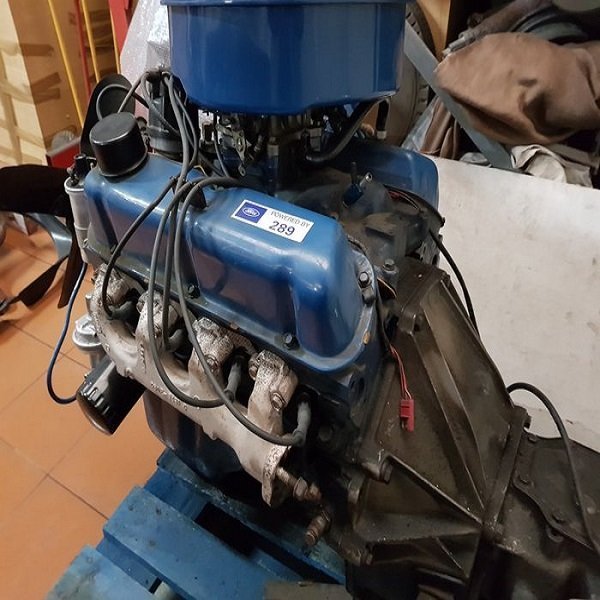
Ford 289 V8 Engine for Sale | OEM Windsor 4.7L Small Block
$1,850.00
Product Overview
- Displacement: 289 cu in (4.7L)
- Engine Family: Ford Windsor Small Block
- Configuration: V8, OHV, 16 valves
- Horsepower: 195 to 271 hp (variant dependent, confirmed at order)
- Torque: 258 to 312 lb-ft (variant dependent)
- Condition: OEM used, compression verified
- Availability: Standard, 4V, and HiPo K-Code variants stocked, call to confirm
- Shipping: Free freight to all 50 states, 5-10 business days
- Every cylinder pressure-tested with variant identification (HiPo versus standard) on file
- Zero core charge required, old engine stays with you
- Backed by a 15 day replacement warranty against internal defects
Did you like this product? Add to favorites now and follow the product.
(+800) 1234 5678 90 Start Live Chat
Description
Engine Background
Ford’s 289 is one of the cornerstone engines of American performance. Introduced in 1963 as the 4-inch-bore evolution of the 260 small block, the 289 became the foundation of the Windsor family and went on to power the first-generation Mustang, the early Shelby GT350 program, and the AC Cobra. With its short deck height, 4.00-inch bore, and willingness to rev, the 289 set the template that the 302 would later refine and the 351 Windsor would scale up.
Three main factory variants exist. The 289 2V (standard) used a 2-barrel carburetor and produced 195 to 200 hp. The 289 4V upgraded to a 4-barrel for 225 hp. The 289 HiPo (K-Code) is the famous one: solid lifters, screw-in rocker studs, larger intake valves, low-restriction exhaust manifolds, and an aggressive cam profile produced 271 hp from the same 4.7-liter displacement. Shelby took the K-Code further with Cobra-spec dual-quad and Tri-Y intakes for the GT350.
For a 1965 to 1967 Mustang restoration, an early Falcon, a Comet, or a Cobra-style build, a documented 289 with the correct variant identification is the engine that earns the project its credibility.
When Replacement Becomes Necessary
- Knock or bottom-end noise under load, typically rod or main bearing wear on a high-mileage unit
- Blue exhaust smoke at startup or under throttle, generally pointing to valve seals or worn piston rings
- Lost compression on one or more cylinders, often from ring failure, scored bores, or head gasket issues
- Cooling system pressurization without external leak, frequently head gasket on Windsor blocks
- Excessive oil consumption past one quart per 1,500 miles, indicating ring or valve seal wear
- Low oil pressure at hot idle on a warmed engine, suggesting main bearing clearance moving out of spec
Known Weak Points
- 5-bolt versus 6-bolt bellhousing change in 1965: Early 289 blocks (1963 to mid-1965) used a 5-bolt bellhousing pattern. Mid-1965 onward switched to the 6-bolt pattern that became the small-block Ford standard. We confirm the pattern on every block before shipment.
- HiPo K-Code authentication: A genuine K-Code is significantly more valuable than a standard 289. Block code, head castings, and rocker stud type (screw-in versus pressed-in) all need to match. We document casting numbers and identification markers on units claimed as K-Code.
- Timing chain wear: The factory timing chain and gear set wears on high-mileage 289s. Replacement during any rebuild is standard practice.
- Cylinder head reproduction supply: Reproductions of K-Code-style heads exist in the market. We document casting numbers so authenticity is verifiable.
- Oil pan and dipstick application differences: Mustang, Fairlane, and Falcon 289s used different oil pans and dipsticks. The oil pan ships with the engine; the dipstick may need to match your chassis.
289 Variant Reference
| Variant | Years | HP | Torque | Key Features |
|---|---|---|---|---|
| 289 2V (standard) | 1963 to 1968 | 195-200 hp | 282 lb-ft | 2-barrel carburetor, hydraulic lifters, mass-production application |
| 289 4V | 1963 to 1968 | 225 hp | 305 lb-ft | 4-barrel carburetor, hydraulic lifters, GT and performance trim |
| 289 HiPo K-Code | 1963 to 1967 | 271 hp | 312 lb-ft | Solid lifters, screw-in rocker studs, low-restriction exhaust, aggressive cam, 10.5:1 compression |
What Ships and What Does Not
INCLUDED (Long Block): Block, crankshaft, pistons, connecting rods, camshaft, cylinder heads, valve train, oil pan, timing cover.
NOT INCLUDED: Intake manifold, carburetor, exhaust manifolds, distributor, ignition system, alternator, power steering pump, A/C compressor, starter, flexplate or flywheel.
Core policy: No core return required.
Direct-Fit Vehicle Applications
| Vehicle | Years |
|---|---|
| Ford Mustang | 1964-1/2 to 1968 |
| Ford Fairlane | 1963 to 1968 |
| Ford Falcon | 1963 to 1968 |
| Mercury Comet and Cyclone | 1963 to 1968 |
| Shelby GT350 | 1965 to 1967 |
| AC Cobra | 1963 to 1965 (260/289) |
| Ford Galaxie (limited) | 1965 to 1968 |
Swap compatibility: The 289 shares the small-block Ford Windsor architecture with the 302 and 351 Windsor. Motor mount locations and bellhousing pattern (post-1965) match the 302. Transmission compatibility: Toploader 4-speed manual | C4 3-speed automatic | T-5 5-speed manual (with aftermarket conversion).
Search Terms Buyers Use
Ford 289 | 289 Windsor engine for sale | 289 4.7L engine | 289 K-code engine | 289 HiPo engine for sale | Ford 289 small block | Mustang 289 engine | Shelby GT350 289 | Cobra 289 engine | 289 ci engine
Used OEM Versus Professional Rebuild
For a 1965 to 1968 Mustang or Falcon restoration where original-spec hardware matters, a documented used OEM 289 is the right starting point. Our units ship with casting numbers, variant identification, and compression results on record. A professional rebuild makes sense for a Shelby clone, a show-quality build, or a K-Code-spec recreation. Rebuilt K-Code-spec 289s in correct configuration typically run $8,000 to $14,000 from established Ford small-block shops. Contact us to discuss the right approach for your build.
Inspection Workflow
- Compression test logged across all 8 cylinders
- Block walk-through for cracks, deck condition, journal scoring, and thread integrity
- Casting number, date code, and variant (2V, 4V, or K-Code) verified and recorded
- Bellhousing pattern (5-bolt early or 6-bolt later) confirmed
- Cylinder head casting numbers documented
- Rocker stud type (screw-in versus pressed-in) noted on K-Code-claimed units
- Gasket surfaces leak-checked for active seepage
Pre-Purchase Buyer Notes
- Bellhousing pattern matters for your transmission choice: Pre-mid-1965 5-bolt blocks need a 5-bolt bellhousing. Confirm your bellhousing on the call so the correct block ships.
- K-Code authentication is detailed work: A real K-Code has specific block markings, head castings, and rocker hardware. We document these but you should verify with a Ford small-block specialist for a numbers-correct restoration.
- Oil pan application differs: Mustang pans clear the front crossmember of a Mustang chassis. A Fairlane or Falcon pan will not necessarily fit a Mustang and vice versa. Confirm your chassis on the call.
- Crankshaft interchangeability with the 302: 289 and 302 crankshafts are different. They are not directly interchangeable in stock configurations. A 302 crank in a 289 block produces a 302; this is a stroker conversation, not a stock rebuild.
Why Part Nests
- Variant identification before payment with 2V, 4V, or K-Code documented
- Casting numbers and date codes recorded for every unit
- Bellhousing pattern confirmed (5-bolt or 6-bolt)
- Compression results logged across all 8 cylinders and shared before order confirmation
- Fitment verified against your specific chassis before shipment
- No core return required
- Free freight pallet delivery nationwide with no hidden fees
- 15 day replacement warranty against internal defects
- Call (240) 306-7051 to speak with someone who knows 289 Windsor variants, K-Code authentication, and Shelby-spec builds
Additional information
| displacement | 289 cu in (4.7L) |
|---|---|
| engine-family | Ford Windsor Small Block |
| configuration | 16 valves, OHV, V8 |
| bore-x-stroke | 4.005 in x 2.870 in |
| firing-order | 1-5-4-2-6-3-7-8 |
| aspiration | Naturally Aspirated |
| block-material | Cast Iron |
| head-material | Cast iron |
| production-years | 1963 to 1968 |
| manufacturer | Ford Motor Company |
| main-bearing-caps | 2-bolt standard | 4-bolt on HiPo K-code |
| horsepower | 195 to 271 hp – confirmed at order |
| torque | 258 to 312 lb-ft – confirmed at order |
| compression-ratio | 8.7:1 to 10.5:1 – variant dependent |
| compatible-transmissions | C4, C6 automatic | Toploader 4-speed manual |
| fuel-system | 2-barrel (C-code) | 4-barrel (A-code) | 595 cfm 4-barrel (K-code) | Holley 715 cfm (Shelby GT350) |
| condition | Compression Tested, Used OEM |
The 289 powered the Ford Mustang (1964-1/2 to 1968), Fairlane (1963 to 1968), Falcon (1963 to 1968), Mercury Comet and Cyclone (1963 to 1968), Shelby GT350 (1965 to 1967), AC Cobra 289 (1963 to 1965), and limited Galaxie applications (1965 to 1968).
The 2V uses a 2-barrel carburetor at 195 to 200 hp. The 4V steps up to a 4-barrel at 225 hp. The K-Code (HiPo) is the special one: solid lifters, screw-in rocker studs, larger valves, low-restriction exhaust manifolds, an aggressive cam, and 10.5:1 compression, producing 271 hp from the same 289 cubic inches.
A real K-Code shows specific block casting markings, particular cylinder head castings, screw-in rocker studs (not pressed-in), and solid lifter valvetrain hardware. We document casting numbers and identifiers on units sold as K-Code, but for a numbers-matching restoration a Ford small-block specialist should verify the engine against the chassis documentation.
They share the Windsor small-block architecture. The 302 increases stroke from 2.87 inches (289) to 3.00 inches. Externally similar, but the cranks are different and a stock 289 crankshaft is not directly interchangeable with a 302 in a standard build.
Possibly. Early 1965 Mustangs (built before approximately April 1965) used the 5-bolt bellhousing pattern. Later 1965 and beyond switched to the 6-bolt pattern. We confirm the block pattern on every shipment so this matches your transmission and bellhousing.
The Toploader 4-speed manual is the most common period-correct manual pairing. The C4 3-speed automatic is the standard automatic. T-5 5-speed conversions are popular for modern drivability.
No. There is no core return required.
Free freight pallet shipping to all 50 states, typically 5 to 10 business days in transit. Provide your ZIP code on the call for an accurate window.
15 Day Replacement Warranty
Every used Ford 289 engine purchased through Part Nests carries a 15 day replacement warranty starting on the delivery date.
What Is Covered
- Internal defects already present when the engine arrives
- Performance materially different from how the engine was described
- Incorrect part shipped due to an error on our end
What Is Not Covered
- Damage caused during installation
- Damage from incompatible components
- External components unless specifically itemized
- Labor expenses of any kind
To start a warranty claim, reach us within 15 days of delivery at (240) 306-7051 or admin@partnests.com.
- Variant Verified: 2V, 4V, or K-Code identified with casting number on file
- Bellhousing Pattern Confirmed: 5-bolt early or 6-bolt later noted before payment
- Head Castings Recorded: Originality question answered up front
- Compression Results Shared: All 8 cylinders logged before your order locks in
- Skip the Core Return: Your old engine stays with you
- 15 Day Replacement Cover: Internal defects protected from delivery onward
2 reviews for Ford 289 V8 Engine for Sale | OEM Windsor 4.7L Small Block
Related products
About Us
At Part Nests, we specialize in high-quality used and OEM auto parts, with a wide selection of components ready to ship to customers.
© 2026 Part Nests. All rights reserved.

Steve P. –
Picked up a 1966 K-Code for a Mustang fastback restoration. Part Nests documented the head castings, rocker stud type, and block markings before I paid a cent. Compression was uniform across the eight cylinders. As close to a correct numbers-matching engine as I have managed to find in years of searching.
Mike L. –
Got a 289 2V for a Falcon project. Honest about it being a workhorse-spec unit, not a K-Code clone. The 6-bolt bellhousing was confirmed before shipment to match my C4. Light seepage at the rear main was flagged in advance and cleaned up during install.