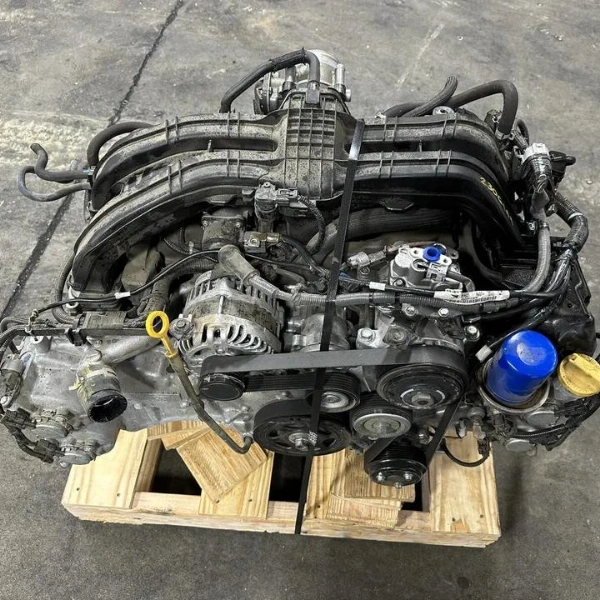
Subaru EJ22 Engine for Sale | OEM 2.2L Naturally Aspirated Boxer (Legacy and Impreza)
$2,499.00
Product Overview
- Displacement: 2,212 cc (2.2L / 135.0 cu in)
- Configuration: Flat-four boxer, SOHC, 16 valves
- Horsepower: 135 to 137 hp (EJ22E) | 160 to 165 hp (EJ22T)
- Torque: 137 lb-ft (EJ22E) | 181 lb-ft (EJ22T)
- Condition: OEM used, compression tested and inspected
- Availability: Multiple year ranges from 1990 to 2001 in stock
- Shipping: Free freight to all 50 states, 5 to 10 business days
- All 4 cylinders pressure-tested with results shared before payment
- Pre-1997 vs post-1997 block generation confirmed, interference status documented
- EJ22E vs EJ22T variant confirmed before every order ships
- Head gasket condition specifically assessed before shipping
- Zero core charge required, your existing engine stays with you
- Backed by a 15 day replacement warranty against internal defects
Did you like this product? Add to favorites now and follow the product.
(+800) 1234 5678 90 Start Live Chat
Description
Engine Background
The Subaru EJ22 is a 2.2-liter horizontally-opposed flat-four boxer engine produced from 1990 through 2001, used primarily in the Subaru Legacy and Impreza for the North American market. It is widely regarded as the most reliable engine in Subaru’s EJ family, a distinction it holds by a significant margin over the EJ25 that replaced it. The EJ22 produces 135 to 137 hp from 2.2 liters and is known for documented service lives exceeding 250,000 to 300,000 miles with regular maintenance. Some owners report 500,000-mile examples.
The EJ22 went through two distinct engineering phases. The Phase I EJ22E (1990 to 1996) used an open deck block design and 9.5:1 compression. Critically, it maintained enough valve-to-piston clearance to be a non-interference engine. If the timing belt breaks, the engine does not suffer valve damage. The Phase II EJ22EZ (1997 to 2001) received revised pistons with molybdenum coating, a higher 9.7:1 compression ratio, and a reshaped piston crown. This change eliminated the valve clearance and made the post-1997 EJ22 an interference engine. We confirm the generation before every order, this is the most important safety distinction for buyers.
The EJ22’s reputation improvement over the EJ25 is relevant to mention for buyers making an informed decision. The 1999 to 2003 EJ25 (251 and 252 variants) has a documented and widely acknowledged head gasket failure rate, external oil and coolant seeping through the head gasket at the deck. The EJ22 does not share this characteristic. For Legacy and Impreza owners whose EJ25 has failed, an EJ22 replacement is worth discussing.
When Replacement Becomes Necessary
- Oil or coolant external seepage at the head gasket junction, while less common than on the EJ25, it can occur on high-mileage or overheated EJ22 units
- Oil consumption beyond one quart per 2,000 miles, valve stem seal or ring wear on high-mileage engines
- Timing belt noise, the EJ22 uses a rubber timing belt. Pre-1997 units are non-interference (safe if belt breaks), post-1997 are interference. Replace at 60,000 to 105,000 miles.
- Rough idle, idle air control valve wear or mass airflow sensor fault on aged EJ22 units
- Loss of compression, ring wear or valve seat failure on high-mileage examples
- Boxer-specific oil leaks at camshaft seals or crankshaft seals, common on aged flat-four engines
Known Issues We Document Before Shipping
- Pre-1997 versus post-1997 interference status, the most critical safety distinction: the pre-1997 EJ22E is non-interference. The post-1997 EJ22EZ IS interference due to revised pistons. Installing a post-1997 unit and not replacing the timing belt immediately puts the owner at risk of valve damage from belt failure. We confirm the generation and interference status for every unit before shipping.
- EJ22T closed deck, better for boost, worse for accessibility: the EJ22T (1991 to 1994 Legacy Turbo) uses a closed deck block (stronger) with no intercooler from the factory. If sourcing an EJ22T for a turbocharged build, the absence of an intercooler from stock is a known limitation. We identify EJ22T versus EJ22E units before shipping.
- Timing belt system complexity on boxer engines: the EJ22’s timing belt drives two camshafts on opposite sides of the engine, a more complex system than inline engines. The belt, tensioner, idler pulleys, and water pump should all be replaced together as a service kit. We assess belt condition where determinable.
- Camshaft and crankshaft seal leaks: the boxer architecture means seals are at the front of both cylinder heads (camshafts) and at the front and rear of the crankshaft. Aged seals leak on high-mileage units. We inspect external seal condition.
- EJ22E head gasket sensitivity to overheating: while dramatically more reliable than the EJ25, the EJ22 can still develop head gasket issues after sustained overheating. We compression test all 4 cylinders and inspect coolant for cross-contamination.
EJ22 Variants by Year and Application
Critical buyer information across the 1990 to 2001 production run:
| Variant | Years | HP | Block | Key Notes |
|---|---|---|---|---|
| EJ22E (Phase I) | 1990 to 1996 | 135 hp | Open deck | Non-interference engine. 9.5:1 compression. Legacy and Impreza NA. Most common and most forgiving- broken belt does not destroy engine. |
| EJ22EZ (Phase II) | 1997 to 2001 | 137 hp | Open deck | Interference engine from 1997. 9.7:1 compression. Revised pistons with molybdenum coating. Slightly more power and better efficiency. |
| EJ22T | 1991 to 1994 | 160 to 165 hp | Closed deck | Legacy Turbo only- USDM. SOHC turbo, no intercooler from factory. 8.1:1 compression. Closed deck is stronger but no piston oil sprayers. Only 8,199 units in USDM. |
| INCLUDED- Long Block | Aluminum flat-four block with cast iron liners, crankshaft, pistons, connecting rods, SOHC camshafts (one per bank), aluminum cylinder heads, valve train, oil pan, timing cover. |
|---|---|
| NOT INCLUDED | Timing belt and tensioner (replace at installation- mandatory on any used EJ22), intake manifold, throttle body, fuel injectors, alternator, power steering pump, A/C compressor, ECU and wiring harness, axle stubs. |
| TIMING BELT NOTE | Replace timing belt, tensioner, all idler pulleys, and water pump at installation. Pre-1997 is non-interference. Post-1997 is interference- broken belt damages head. |
| Core Note | No core charge. You are not required to return your old engine. |
What Ships and What Does Not
| Subaru Legacy (1st and 2nd generation- NA) | 1990 to 1999- primary application |
|---|---|
| Subaru Legacy Turbo | 1991 to 1994- EJ22T closed deck turbocharged variant |
| Subaru Impreza | 1993 to 1996- NA EJ22E |
| Swap Applications | EJ22 is sometimes used as a head gasket failure replacement for EJ25-equipped Legacy and Impreza models, eliminating the EJ25's head gasket reputation in appropriate applications |
Direct-Fit Vehicle Applications
| Subaru EJ22 | Most common buyer search |
|---|---|
| EJ22 engine | Short code buyer |
| Subaru 2.2L engine | Displacement buyer |
| EJ22E | Phase I specific buyer |
| Legacy 2.2 engine | Application buyer |
| Subaru boxer engine 2.2 | Configuration buyer |
| EJ22 non-VTEC Subaru | Comparison-aware buyer |
| EJ22 flat four | Architecture buyer |
| Subaru 2.2 replacement | Replacement buyer intent |
| EJ22 vs EJ25 | Comparison research buyer- very high intent |
Used OEM Versus Specialist Rebuild
For a Subaru Legacy or Impreza with EJ22 failure or for an EJ25 replacement, a documented used EJ22 with generation confirmed and interference status disclosed is the cost-effective path. The EJ22’s inherent durability typically makes replacement more economical than rebuild for street applications. For a turbocharged EJ22T build foundation or a high-performance Outback Sport project, a specialist refresh with fresh head gaskets, refreshed timing components, and updated seals is the better long-term investment. Specialist EJ22 rebuilds typically run $2,800 to $4,500 from established Subaru shops.
Inspection Workflow
- Compression test logged across all 4 cylinders with uniformity reported
- Pre-1997 versus post-1997 block generation confirmed (interference status flagged)
- EJ22E versus EJ22T variant confirmed
- Head gasket condition assessed via coolant cross-contamination check
- Timing belt condition evaluated where determinable
- Camshaft and crankshaft seal areas inspected for seepage
- External oil leak survey at valve covers, oil pan, separator plate
Pre-Purchase Buyer Notes
- Match generation to chassis: pre-1997 EJ22E and post-1997 EJ22EZ have different intake manifolds, ECU compatibility, and (most importantly) different interference status. Match generation to chassis year.
- Replace the timing belt at installation regardless of donor history: this is non-negotiable on the post-1997 interference EJ22 and strongly recommended on the pre-1997 non-interference version. Always install fresh belt, tensioner, idler pulleys, and water pump as a complete service kit.
- Plan head gasket refresh on overheated donor units: aged EJ22 head gaskets are less problematic than EJ25 but can still leak. Inexpensive insurance against post-install coolant problems.
- Use Subaru-specification coolant: typically Subaru Super Coolant or equivalent. The EJ22 cooling system is sensitive to coolant chemistry; generic universal coolants can degrade head gasket sealing surfaces over time.
- For EJ22T builds, plan supporting modifications: the factory EJ22T came without an intercooler. Adding an intercooler at install is a near-mandatory upgrade for sustained boost reliability.
Why Buy From Part Nests
- Block generation confirmed: pre-1997 (non-interference) or post-1997 (interference) documented before payment
- Variant confirmed: EJ22E (naturally aspirated) or EJ22T (turbo) verified
- Head gasket condition assessed for cross-contamination
- Timing belt condition evaluated where determinable
- All 4 cylinders compression-tested with uniformity reported
- Camshaft and crankshaft seal areas externally inspected
- No core return required
- Free freight delivery to every state
- 15 day replacement warranty against internal defects
- Call (240) 306-7051 to speak with someone who knows EJ22 pre-1997 vs post-1997 interference status, EJ22 as EJ25 replacement option, and Subaru Legacy versus Impreza application matching
Additional information
| displacement | 2, 212 cc (2.2L / 135.0 cu in) |
|---|---|
| engine-code | EJ22E (NA) | EJ22EZ (Phase II NA) | EJ22T (turbo- Legacy Turbo only) |
| configuration | 16 valves, Flat-four boxer, SOHC |
| bore-x-stroke | 96.9 mm x 75 mm |
| compression-ratio | 9.5:1 (pre-1997 EJ22E) | 9.7:1 (post-1997 EJ22EZ) | 8.1:1 (EJ22T) |
| horsepower | 135 to 137 hp (EJ22E) | 160 to 165 hp (EJ22T) |
| torque | 137 lb-ft (EJ22E) | 181 lb-ft (EJ22T) |
| block-design | Open deck (EJ22E) | Closed deck (EJ22T only) |
| block-material | Aluminum alloy with cast iron liners |
| head-material | Aluminum alloy |
| timing-system | Rubber timing belt- pre-1997 NON-interference | post-1997 INTERFERENCE |
| production-years | 1990 to 2001 |
| manufacturer | Subaru (Fuji Heavy Industries) |
| head-gasket-reputation | No significant head gasket reputation- distinct advantage over EJ25 replacement |
| applications | Subaru Legacy (1990 to 1999 NA) | Subaru Legacy Turbo (1991 to 1994) | Subaru Impreza (1993 to 1996) |
| condition | compression tested and inspected, Used OEM |
Related products
About Us
At Part Nests, we specialize in high-quality used and OEM auto parts, with a wide selection of components ready to ship to customers.
© 2026 Part Nests. All rights reserved.

Reviews
There are no reviews yet.