
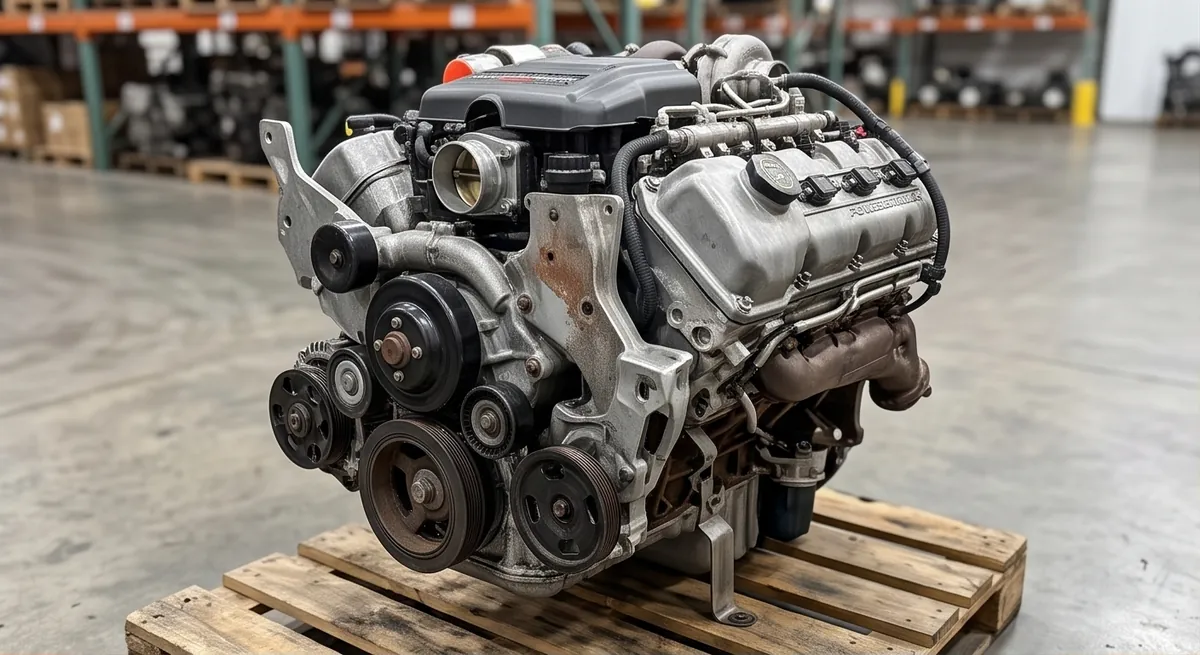
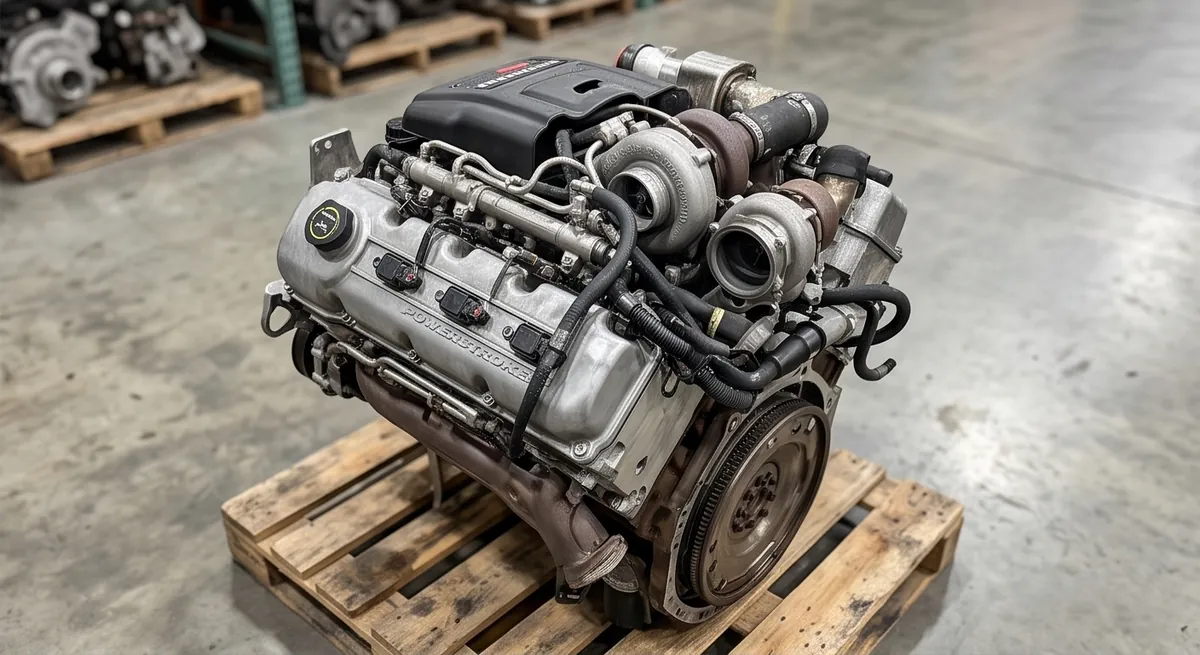
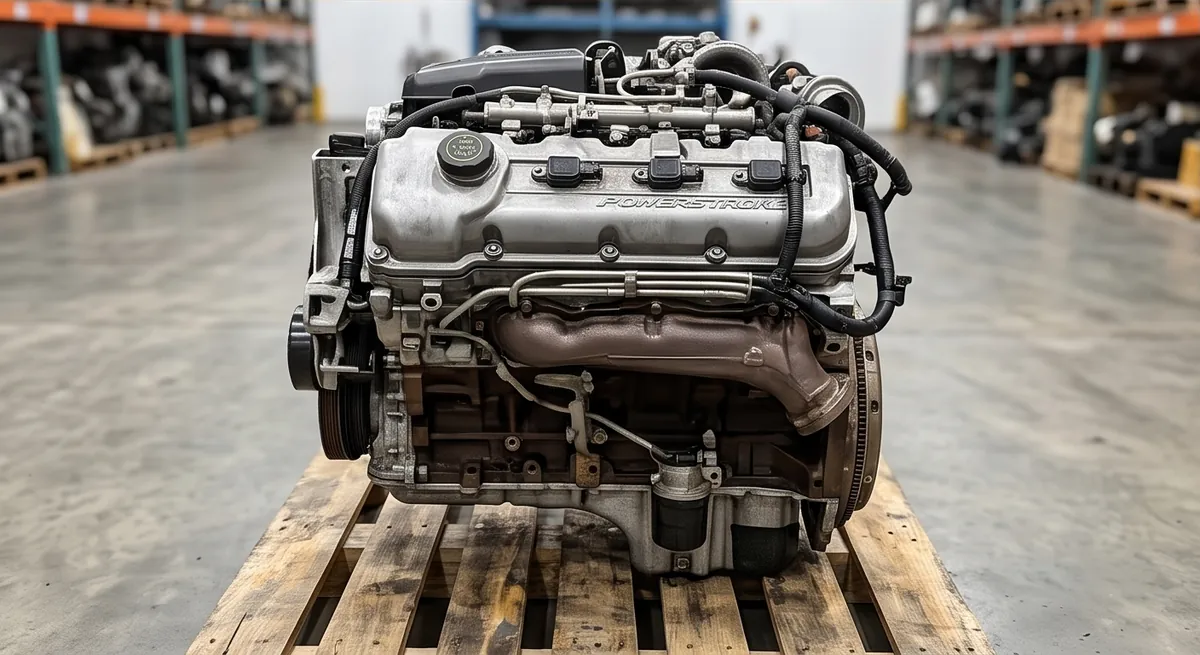
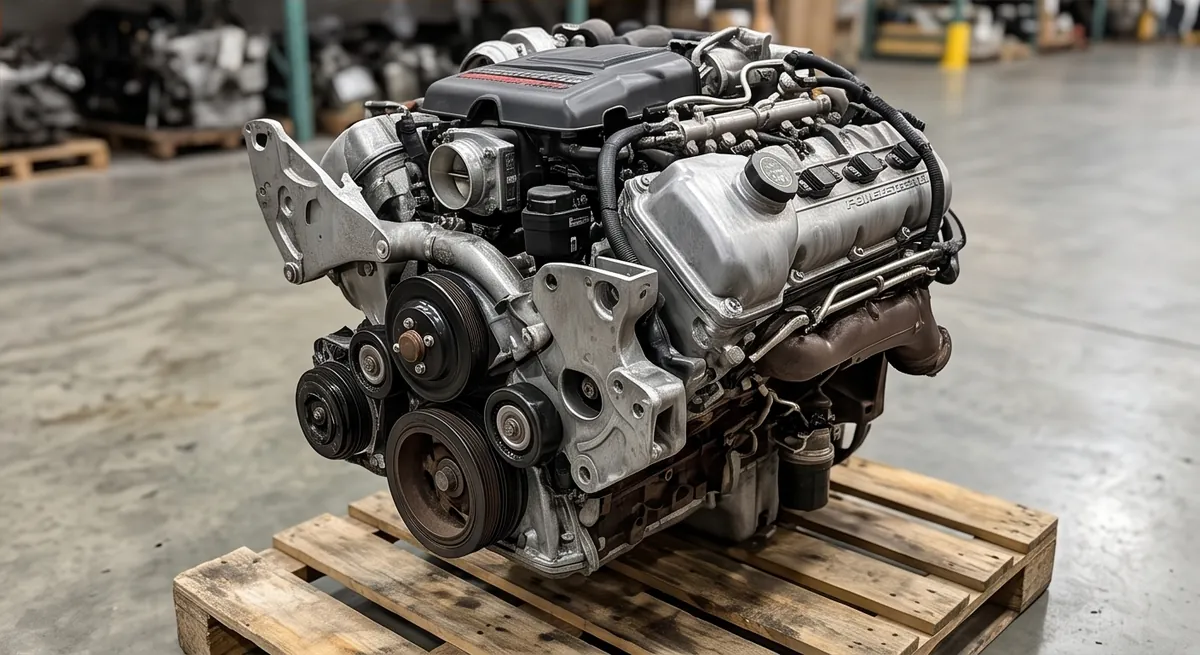
6.4 Powerstroke Engine for Sale | OEM Used Ford / Navistar 6.4L V8 Turbo Diesel Produced 2008 to 2010 for Ford F-250, F-350, F-450
$7,499.00
At a Glance
- Condition: OEM used, all 8 cylinders compression tested with results documented
- Availability: In stock, Ford 6.4L Powerstroke engines available (limited quantities)
- Shipping: Free shipping to all 50 states via freight pallet, 7 to 14 business days
- Year verified (2008 / 2009 / 2010 model year)
- Donor truck confirmed (F-250 / F-350 / F-450 / F-550)
- Oil sample analysis performed (fuel-in-oil dilution check)
- Piston inspection via borescope where possible (cylinder #2 and #7 crack check)
- EGR cooler condition assessed (both coolers, known wear point)
- DPF condition documented
- Compound turbo function verified (HP and LP stages)
- HPFP fuel pressure verified
- Up-pipe inspection performed (known crack point)
- Backed by a 15 day replacement warranty against internal defects
Description
About the 6.4 Powerstroke Engine
Are you searching for a used 6.4 Powerstroke engine for your 2008 to 2010 Ford Super Duty? You have come to the right place for honest information about this engine. The Ford / Navistar 6.4L Powerstroke is a powerful V8 turbo diesel producing 350 HP and 650 lb-ft of torque, with a compound turbocharger setup that delivers strong power across the RPM range. However, the 6.4 Powerstroke has well-documented reliability concerns that any potential buyer should understand before making a purchase decision. At Part Nests we believe in honest disclosure: this page tells you both what is good about the 6.4 Powerstroke and what to watch for. Our goal is to help you make an informed decision so you get the right outcome for your truck.
6.4 Powerstroke Engine Overview
The 6.4 Powerstroke is a 6.4 liter V8 turbocharged diesel engine produced by International Truck and Engine Corporation (Navistar) for Ford Motor Company from 2008 through 2010 model years. It was the successor to the troubled 6.0L Powerstroke (2003 to 2007) and was itself replaced by the much-improved in-house Ford 6.7L Powerstroke for the 2011 model year. The 6.4 was the last Navistar-built Powerstroke engine: after the documented reliability problems with both the 6.0L and 6.4L, Ford terminated its long-running partnership with Navistar (which had supplied Powerstroke diesels since 1994) and began designing the 6.7L Powerstroke in-house. The 6.4 Powerstroke is closely related to the International MaxxForce 7 used in non-Ford commercial truck applications.
Honest Disclosure: What You Need to Know Before Buying a 6.4 Powerstroke
Before discussing the engine specifications and features, we want to be upfront about the 6.4 Powerstroke reputation in the diesel community. The 6.4 Powerstroke has documented reliability concerns that are widely known among Ford Super Duty enthusiasts and diesel technicians. Common failure modes include:
- Catastrophic Piston Cracking, especially in cylinders #2 and #7. The pistons can develop cracks that lead to coolant intrusion and complete engine failure.
- Dual EGR Cooler Failures, both EGR coolers (the 6.4 has two) commonly crack and leak coolant into the intake, causing white smoke and eventually hydrolock or coolant-related engine damage.
- Fuel-in-Oil Dilution, the HPCR fuel system can leak fuel into the engine oil through failed injector seals or fuel pump issues, leading to crankshaft bearing damage as the fuel-diluted oil loses its lubrication properties.
- DPF (Diesel Particulate Filter) Clogging, the 6.4 was the first Powerstroke with DPF, and the system is prone to clogging and constant regeneration, causing fuel economy degradation and potential downstream issues.
- Radiator Failures, the plastic radiator end tanks crack under thermal stress, causing coolant loss.
- Up-Pipe Cracking, the exhaust up-pipes from the heads to the turbo can crack at the welded joints, causing exhaust leaks and boost loss.
- HPFP (High-Pressure Fuel Pump) Failures, the high-pressure fuel pump can fail and contaminate the entire fuel system with metal particles.
- Poor Fuel Economy, the 6.4 averages 10 to 13 MPG in typical use, significantly worse than the 6.7L Powerstroke that replaced it.
Average lifespan without major repair is approximately 100,000 to 150,000 miles, significantly less than the legendary 7.3L Powerstroke (often 400,000 plus miles) or the modern 6.7L Powerstroke (250,000 plus miles routinely). The 6.4 Powerstroke was produced for only three model years (2008, 2009, 2010) precisely because of these concerns.
Why Then Would Someone Buy a 6.4 Powerstroke
Despite the issues, there are valid reasons to source a used 6.4 Powerstroke:
- You own a 2008 to 2010 Ford Super Duty and need a replacement engine. Sourcing a used 6.4 is typically affordableer than swapping to a 6.7L or 7.3L (which would require ECM, harness, transmission, and fuel system changes).
- The strong factory power output, 350 HP and 650 lb-ft of torque, is competitive for its era and the compound turbo gives it strong towing characteristics.
- Aftermarket “bulletproofing”, the diesel performance community has developed extensive solutions for known 6.4 issues, including improved EGR coolers, stronger pistons, ARP head studs, fuel-in-oil mitigation, and DPF / EGR delete kits (for off-road and competition use only).
- Workhorse capability when maintained properly, owners who proactively address known issues with preventive bulletproofing often get 200,000 plus miles of reliable service.
Heavy-Duty Diesel Engine Family Context
The 6.4 Powerstroke (this listing) is the Ford / Navistar V8 turbo diesel for the 2008-2010 Ford Super Duty applications. For buyers comparing heavy-duty diesel engines across OEMs and architectures: the 6.4 Powerstroke (this listing, 6.4L V8 turbocharged diesel with compound turbo setup, HPCR fuel injection over 26,000 PSI, dual EGR coolers, DPF aftertreatment, 350 HP and 650 lb-ft, used in Ford F-250 / F-350 / F-450 / F-550 Super Duty 2008-2010, the LAST Navistar-built Powerstroke before Ford brought diesel design in-house with the 6.7L) is the Ford / Navistar V8 turbo diesel from a documented troubled era. For comparison, the Cummins ISB 6.7L (our vaz180 listing, inline-6 turbocharged diesel with VGT turbocharger and HPCR fuel injection over 30,000 PSI, four generations from 2007.5 through current production, 350-420 HP and 610-1,075 lb-ft, used in Dodge / Ram 2500 / 3500 / 4500 / 5500 heavy-duty pickups and Freightliner Business Class M2 medium-duty trucks, cast iron block and head, legendary B-series Cummins reliability with 500,000 plus mile commercial service life common) is the Mopar inline-6 turbo diesel alternative for HD pickup applications. Two different heavy-duty diesel approaches from the same era: 6.4 Powerstroke V8 with compound turbo and documented reliability concerns; Cummins 6.7 ISB Inline-6 per vaz180 with VGT turbo and legendary B-series reliability across four refined generations. Both engines have aftermarket bulletproofing ecosystems, but the Cummins reputation is significantly stronger for long-term commercial service life. For Ford Super Duty owners considering platform alternatives, the 6.7L Powerstroke (the in-house Ford diesel that replaced the Navistar 6.4 starting model year 2011) is significantly more reliable; for Ram HD owners, the Cummins 6.7 per vaz180 has been the dominant choice since 2007.5.
6.4 Powerstroke Engine Technical Features
- Compound Turbocharger Setup: The 6.4 uses a compound turbo system (NOT simple parallel twin turbos as sometimes described). One smaller high-pressure turbo handles low-RPM boost; a larger low-pressure turbo handles high-RPM boost. The two turbos work in series for maximum boost capability across the entire RPM range.
- High-Pressure Common Rail Fuel Injection: Delivers fuel at extreme pressures (over 26,000 PSI) for optimized combustion efficiency.
- Dual EGR Coolers: Two EGR coolers help meet emissions regulations. Unfortunately, this is also a known failure point.
- Cast Iron Block and Heads: The 6.4 uses cast iron throughout (NOT aluminum heads as sometimes incorrectly listed) for durability. Some references describe the block as CGI (compacted graphite iron) for additional strength.
- 17.5:1 Compression Ratio: Standard for a heavy-duty diesel.
- OHV Pushrod Valvetrain with 4 Valves per Cylinder: 32 valves total provide good breathing for power output.
- DPF / DOC / Exhaust Aftertreatment: The 6.4 was the first Powerstroke with full diesel aftertreatment (DPF and DOC). No DEF / SCR yet (that came with the 6.7L).
- Exhaust Brake: Integrated exhaust brake helps manage speed on downhill grades, valuable for heavy towing.
- Advanced Cooling System: Heavy-duty radiator and oil cooler to handle the heat output of compound turbo operation.
The 6.4 Powerstroke Engine Vehicle Applications
The 6.4 Powerstroke is found exclusively in Ford Super Duty trucks:
- Ford F-250 Super Duty (2008 to 2010)
- Ford F-350 Super Duty (2008 to 2010)
- Ford F-450 Super Duty (2008 to 2010)
- Ford F-550 Super Duty (2008 to 2010)
The 6.4 was NOT used in:
- F-150 (which uses smaller engines)
- E-Series vans (Ford retained the older 6.0L Powerstroke in E-Series longer)
- F-650 / F-750 medium-duty (which used the larger Cummins ISB or Navistar MaxxForce engines)
Performance and Power
- Horsepower: 350 HP at 3,000 RPM
- Torque: 650 lb-ft at 2,000 RPM
- Modified Performance: With proper bulletproofing and tuning, the 6.4 can be safely modified to 500 to 600 HP. Beyond that, the engine internals become unreliable.
Recommended Aftermarket Bulletproofing for Long-Term Reliability
If you install a used 6.4 Powerstroke, we strongly recommend the following preventive bulletproofing modifications:
- Improved EGR coolers (Bullet Proof Diesel, Sinister Diesel), addresses the #1 reliability concern
- ARP head studs, prevents head gasket failures under stress
- Coolant system upgrade (aluminum radiator), replaces the failure-prone plastic end tank radiator
- EGR / DPF delete kit, for off-road and competition use only; significantly improves reliability and fuel economy but is not street legal in any US state
- Quality fuel filter system (S&B, FASS), extends HPFP life by removing water and contamination
- Preventive fuel system flush, clears any pre-existing metal contamination from prior HPFP issues
- Forged piston upgrade (if budget allows), eliminates the cylinder #2 and #7 piston cracking risk
Vehicle Compatibility
| Vehicle | Compatibility |
|---|---|
| Ford F-250 Super Duty (2008 to 2010) | All cab and bed configurations |
| Ford F-350 Super Duty (2008 to 2010) | All cab and bed configurations, single and dual rear wheel |
| Ford F-450 Super Duty (2008 to 2010) | Chassis cab and pickup |
| Ford F-550 Super Duty (2008 to 2010) | Chassis cab work truck |
| NOT Applicable | F-150 (uses gas engines), E-Series vans (used older 6.0L), F-650 / F-750 (used Cummins ISB or MaxxForce) |
| Compatible Transmissions | Ford 5R110W TorqShift 5-speed automatic and 6R140 TorqShift 6-speed automatic |
Why Buy From Part Nests
- Honest disclosure of 6.4 Powerstroke known issues before you commit
- All 8 cylinders compression tested before shipping
- Oil sample analysis for fuel-in-oil dilution
- Piston borescope inspection for cylinder #2 and #7 cracking
- Both EGR coolers inspected (known failure point)
- Compound turbo function verified
- Free freight pallet delivery to all 50 states
- 15 day replacement warranty on internal defects
- Bulletproofing strategy consultation available
- Honest discussion of 6.7L Powerstroke upgrade alternative if appropriate for your situation
- Call (855) 634-4447 to confirm Ford 6.4L Powerstroke engine (Navistar-built V8 turbocharged diesel produced 2008-2010 model years, the LAST Navistar-built Powerstroke before Ford terminated the long-running Navistar partnership and began designing the 6.7L Powerstroke in-house for 2011 plus, closely related to the International MaxxForce 7 used in non-Ford commercial truck applications), donor truck (Ford F-250 Super Duty 2008-2010, F-350 Super Duty 2008-2010 single and dual rear wheel, F-450 Super Duty 2008-2010 chassis cab and pickup, or F-550 Super Duty 2008-2010 chassis cab work truck), year verified (2008 / 2009 / 2010), all 8 cylinder compression test results, oil sample analysis for fuel-in-oil dilution check (a known wear mode causing crankshaft bearing damage), piston inspection via borescope where possible for cylinder #2 and #7 crack check (the catastrophic piston cracking failure mode), both EGR cooler condition (the dual EGR cooler design is a known failure point causing white smoke and hydrolock risk), DPF condition documented (the first Powerstroke with diesel particulate filter, prone to clogging), compound turbocharger function verified for both HP and LP stages (NOT simple parallel twin turbos despite some descriptions, the two turbos work in series for maximum boost across entire RPM range), HPFP high-pressure fuel pump pressure verified (known failure point that can contaminate the entire fuel system with metal particles), up-pipe inspection for crack at welded joints (known wear point), bulletproofing strategy consultation, the 6.4 Powerstroke documented reliability concerns (approximately 100,000-150,000 mile average lifespan without major repair, significantly less than the legendary 7.3L 400,000+ miles or modern 6.7L 250,000+ miles routinely), and heavy-duty diesel family context (6.4 Powerstroke Ford / Navistar V8 with compound turbo vs Cummins 6.7L per vaz180 Inline-6 with VGT turbo and legendary B-series reliability across four refined generations 2007.5-current) before ordering
15 Day Replacement Warranty
Every used Ford 6.4L Powerstroke engine purchased through Part Nests carries a 15 day replacement warranty starting on the delivery date.
What Is Covered
- Internal defects already present when the engine arrives
- Compression failures on any of the 8 cylinders beyond what was disclosed
- Cylinder head crack failures within 15 days from installation
- Block crack failures within 15 days from installation
- Piston cracking failures within 15 days from installation (where pre-purchase borescope inspection documented serviceable condition for cylinders #2 and #7)
- EGR cooler failures within 15 days from installation (where condition was documented as serviceable at shipping)
- Compound turbocharger failures within 15 days from installation (HP and LP stages)
- HPFP fuel pump failures within 15 days from installation
- Connecting rod, lifter, or bearing failures within 15 days from installation
- Incorrect year shipped (2008 / 2009 / 2010 mismatch) due to an error on our end
What Is Not Covered
- Damage caused during installation
- Damage from contaminated diesel fuel (the HPCR fuel system is sensitive to fuel contamination; water or particulate contamination can damage the high-pressure fuel pump and injectors)
- Damage from extended oil change intervals or operating with fuel-diluted oil (the 6.4 fuel-in-oil dilution is a known wear mode requiring proactive oil sample monitoring)
- Damage from neglected EGR cooler maintenance (the dual EGR cooler design is a known failure point; aftermarket bulletproofing is strongly recommended)
- Damage from neglected DPF maintenance or DPF / EGR delete tunes (delete tunes are illegal under EPA regulations and are for off-road and competition use only; while they improve reliability, they remove emissions hardware)
- Damage from operating with cracked up-pipes causing boost leak (a known wear point requiring inspection)
- Damage from cooling system neglect including the failure-prone plastic radiator end tanks (aluminum radiator upgrade is strongly recommended)
- Damage from aggressive aftermarket tuning beyond approximately 500-600 HP without supporting forged internals
- Damage from operating without quality fuel filter system (S&B, FASS, or equivalent strongly recommended)
- External components (ECM, harness, intake manifold, exhaust manifold, EGR cooler if separately documented, DPF / aftertreatment system, starter, alternator, water pump, transmission, AC compressor, accessories) unless itemized
- Labor expenses of any kind
To start a warranty claim, reach us within 15 days of delivery at (855) 634-4447.
- All 8 Cylinders Tested: Compression results documented before payment
- Year Verified: 2008 / 2009 / 2010 model year correctly identified
- Honest Disclosure: 6.4 Powerstroke known reliability concerns transparently communicated before purchase
- Oil Sample Analysis Performed: Fuel-in-oil dilution check (a known wear mode)
- Piston Borescope Inspection: Cylinder #2 and #7 crack check (the catastrophic piston cracking failure mode)
- 15 Day Replacement Cover: Internal defects protected from delivery onward
Additional information
| aspiration | Compound turbocharged (high-pressure plus low-pressure turbos in series, NOT simple parallel twin turbos) |
|---|---|
| bore-x-stroke | 3.87 inches x 4.13 inches |
| compression-ratio | 17.5:1 |
| cooling-system | Liquid-cooled with heavy-duty radiator and oil cooler |
| electrical-system | 12-volt with dual alternators |
| fuel-system | High-Pressure Common Rail (HPCR) direct fuel injection |
| fuel-type | Diesel (Ultra Low Sulfur Diesel, ULSD) |
Ford / Navistar V8 turbocharged diesel engine produced 2008-2010 for Ford Super Duty trucks. The 6.4 Powerstroke is a 6.4 liter V8 turbocharged diesel engine produced by International Truck and Engine Corporation (Navistar) for Ford Motor Company from 2008 through 2010 model years. Features: 6.4L V8 displacement, compound turbocharger setup (NOT simple parallel twin turbos), high-pressure common-rail (HPCR) fuel injection over 26,000 PSI, dual EGR coolers, DPF / DOC exhaust aftertreatment (the first Powerstroke with DPF), cast iron block and heads, 17.5:1 compression ratio, OHV pushrod valvetrain with 4 valves per cylinder (32 valves total), integrated exhaust brake. Output: 350 HP at 3,000 RPM and 650 lb-ft at 2,000 RPM. The LAST Navistar-built Powerstroke before Ford ended the Navistar partnership and designed the 6.7L Powerstroke in-house for 2011 plus.
Multiple well-known failure modes that potential buyers should understand. The 6.4 Powerstroke has documented reliability concerns widely known among Ford Super Duty enthusiasts and diesel technicians. Catastrophic piston cracking: especially in cylinders #2 and #7, the pistons can develop cracks leading to coolant intrusion and complete engine failure. Dual EGR cooler failures: both EGR coolers commonly crack and leak coolant into the intake, causing white smoke and eventually hydrolock or coolant-related engine damage. Fuel-in-oil dilution: the HPCR fuel system can leak fuel into the engine oil through failed injector seals or fuel pump issues, leading to crankshaft bearing damage. DPF clogging: prone to clogging and constant regeneration, causing fuel economy degradation. Radiator failures: plastic radiator end tanks crack under thermal stress. Up-pipe cracking: exhaust up-pipes from the heads to the turbo can crack at the welded joints. HPFP failures: the high-pressure fuel pump can fail and contaminate the entire fuel system with metal particles. Poor fuel economy: 10-13 MPG typical, significantly worse than the 6.7L Powerstroke. Average lifespan without major repair is approximately 100,000-150,000 miles, significantly less than the legendary 7.3L (400,000+ miles) or modern 6.7L (250,000+ miles routinely).
Valid reasons exist despite the reliability concerns. You own a 2008-2010 Ford Super Duty and need a replacement engine: sourcing a used 6.4 is typically affordableer than swapping to a 6.7L or 7.3L (which would require ECM, harness, transmission, and fuel system changes plus chassis modifications). Strong factory power output: 350 HP and 650 lb-ft of torque is competitive for its era, and the compound turbo gives it strong towing characteristics. Aftermarket bulletproofing: the diesel performance community has developed extensive solutions for known 6.4 issues, including improved EGR coolers (Bullet Proof Diesel, Sinister Diesel), stronger pistons, ARP head studs, fuel-in-oil mitigation, and DPF / EGR delete kits (for off-road and competition use only, illegal for street use). Workhorse capability when maintained properly: owners who proactively address known issues with preventive bulletproofing often get 200,000 plus miles of reliable service.
Two turbos in series, NOT parallel twin turbos. The 6.4 uses a compound turbo system that often gets incorrectly described as parallel twin turbos. In a compound turbo setup, one smaller high-pressure turbo handles low-RPM boost while a larger low-pressure turbo handles high-RPM boost, and the two turbos work in SERIES for maximum boost capability across the entire RPM range. The HP turbo spools first at low RPM providing quick boost response; as RPM rises, the LP turbo takes over and provides high-flow capacity. The compound setup gives the 6.4 strong low-end response (matching a small turbo) with high-RPM flow capacity (matching a large turbo), which contributes to the strong towing characteristics despite the engine other reliability concerns. We verify both HP and LP turbo stages function correctly on every 6.4 we ship.
Ford Super Duty F-250 / F-350 / F-450 / F-550 (2008-2010 only). The 6.4 Powerstroke is found exclusively in Ford Super Duty trucks across the 2008, 2009, and 2010 model years: Ford F-250 Super Duty (2008-2010 all cab and bed configurations), Ford F-350 Super Duty (2008-2010 all cab and bed configurations, single and dual rear wheel), Ford F-450 Super Duty (2008-2010 chassis cab and pickup), Ford F-550 Super Duty (2008-2010 chassis cab work truck). The 6.4 was NOT used in: F-150 which uses smaller engines, E-Series vans (Ford retained the older 6.0L Powerstroke in E-Series longer), F-650 / F-750 medium-duty which used the larger Cummins ISB or Navistar MaxxForce engines. Compatible transmissions: Ford 5R110W TorqShift 5-speed automatic and 6R140 TorqShift 6-speed automatic.
Different heavy-duty diesel approaches with very different reliability reputations. The 6.4 Powerstroke (this listing) is the Ford / Navistar V8 turbocharged diesel with compound turbo setup, HPCR fuel injection over 26,000 PSI, dual EGR coolers (a known failure point), DPF aftertreatment, used in Ford F-250 / F-350 / F-450 / F-550 Super Duty 2008-2010 only, with documented reliability concerns and approximately 100,000-150,000 mile average lifespan without major repair. The Cummins ISB 6.7L (our vaz180 listing) is the Inline-6 turbocharged diesel with VGT turbocharger and HPCR fuel injection over 30,000 PSI, four generations from 2007.5 through current production, 350-420 HP and 610-1,075 lb-ft across generations, used in Dodge / Ram 2500 / 3500 / 4500 / 5500 heavy-duty pickups and Freightliner Business Class M2 medium-duty trucks, cast iron block and head, with legendary B-series Cummins reliability and 500,000 plus mile commercial service life common. Both engines have aftermarket bulletproofing ecosystems, but the Cummins per vaz180 reputation is significantly stronger for long-term commercial service life. The 6.4 Powerstroke was the LAST Navistar-built Powerstroke before Ford terminated the long-running Navistar partnership and designed the 6.7L Powerstroke in-house for 2011 plus, which is significantly more reliable than the 6.4 Navistar-built predecessor.
Multiple preventive modifications strongly recommended for long-term reliability. If you install a used 6.4 Powerstroke, we strongly recommend the following preventive bulletproofing modifications. Improved EGR coolers (Bullet Proof Diesel, Sinister Diesel): addresses the #1 reliability concern of dual EGR cooler failures. ARP head studs: prevents head gasket failures under stress. Coolant system upgrade with aluminum radiator: replaces the failure-prone plastic end tank radiator. EGR / DPF delete kit: significantly improves reliability and fuel economy but is for off-road and competition use only and is not street legal in any US state. Quality fuel filter system (S&B, FASS): extends HPFP life by removing water and contamination. Preventive fuel system flush: clears any pre-existing metal contamination from prior HPFP issues. Forged piston upgrade if budget allows: eliminates the cylinder #2 and #7 piston cracking risk. With proper bulletproofing, the 6.4 Powerstroke can be safely modified to 500-600 HP and provide 200,000 plus miles of reliable service.
No. There is no core return required.
2 reviews for 6.4 Powerstroke Engine for Sale | OEM Used Ford / Navistar 6.4L V8 Turbo Diesel Produced 2008 to 2010 for Ford F-250, F-350, F-450
Related products



Augustus K. –
Got a 6.4 Powerstroke for a 2009 Ford F-350 Super Duty replacement (within the 2008-2010 production window, the LAST Navistar-built Powerstroke before Ford terminated the long-running partnership and designed the 6.7L Powerstroke in-house for 2011 plus). Year verified as 2009, donor truck confirmed as F-350 Super Duty (matching destination), all 8 cylinders compression tested with results documented, oil sample analysis performed (fuel-in-oil dilution check for the known wear mode causing crankshaft bearing damage), piston inspection via borescope (cylinder #2 and #7 crack check for the catastrophic piston cracking failure mode), both EGR coolers inspected (the dual EGR cooler design known failure point), DPF condition documented, compound turbocharger function verified (HP and LP stages tested independently, NOT simple parallel twin turbos despite some descriptions), HPFP fuel pressure verified, up-pipe inspection performed (the known crack point at welded joints). Honest pre-purchase information about the 6.4 Powerstroke documented reliability concerns (approximately 100,000-150,000 mile average lifespan without major repair, significantly less than the legendary 7.3L 400,000+ miles or modern 6.7L 250,000+ miles routinely) and the heavy-duty diesel family context (6.4 Powerstroke Ford / Navistar V8 with compound turbo vs Cummins 6.7L per vaz180 Inline-6 with VGT turbo and legendary B-series reliability across four refined generations).
Cordelia M. –
Sourced a 6.4 Powerstroke for a 2010 Ford F-450 Super Duty chassis cab rebuild (the final year of 6.4 Powerstroke production before Ford brought diesel design in-house with the 6.7L for 2011). Year verified as 2010, donor truck identified as F-450 Super Duty chassis cab, oil sample analysis performed clean, piston borescope inspection completed for cylinders #2 and #7, both EGR coolers inspected, DPF condition documented. Honest pre-purchase information about the recommended aftermarket bulletproofing for long-term reliability (improved EGR coolers like Bullet Proof Diesel or Sinister Diesel addressing the #1 concern, ARP head studs, aluminum radiator replacing the failure-prone plastic end tank, quality fuel filter system like S&B or FASS, forged piston upgrade if budget allows) and the bulletproofing-enabled 200,000 plus miles of reliable service vs the stock 100,000-150,000 mile typical lifespan.