
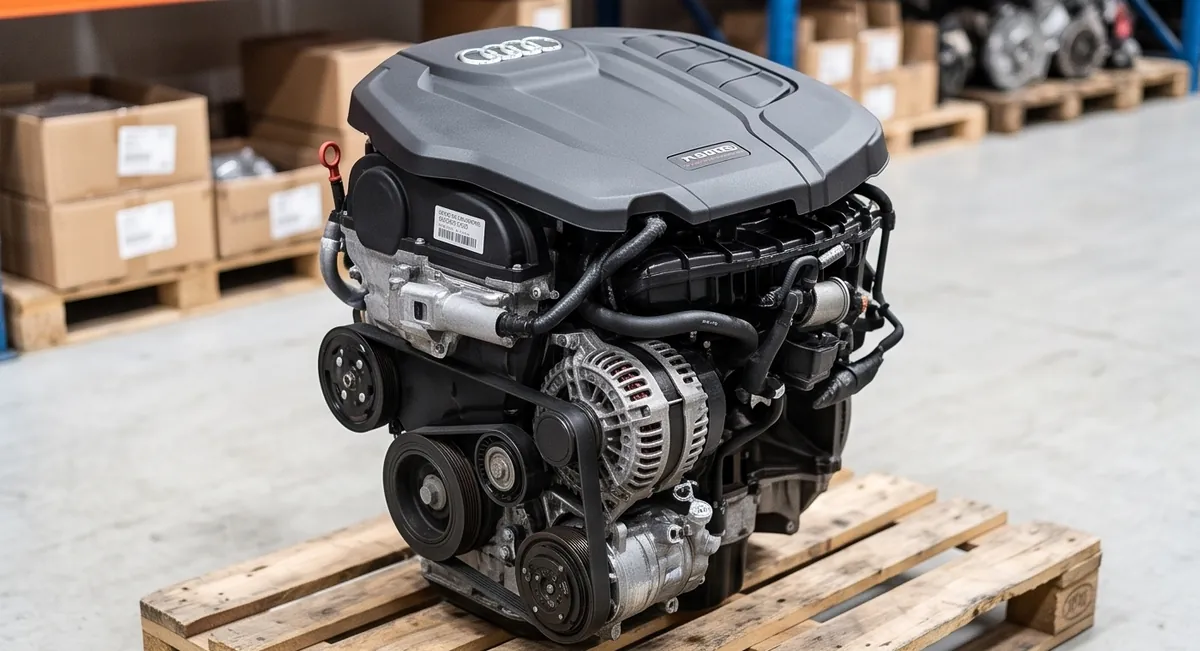
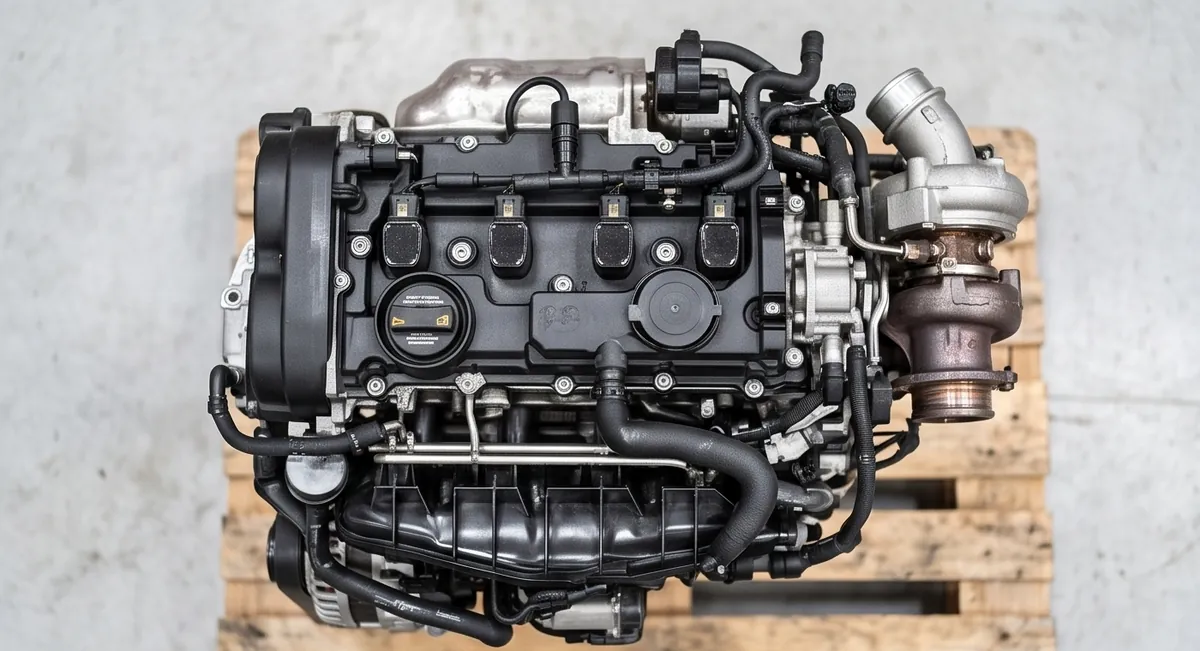
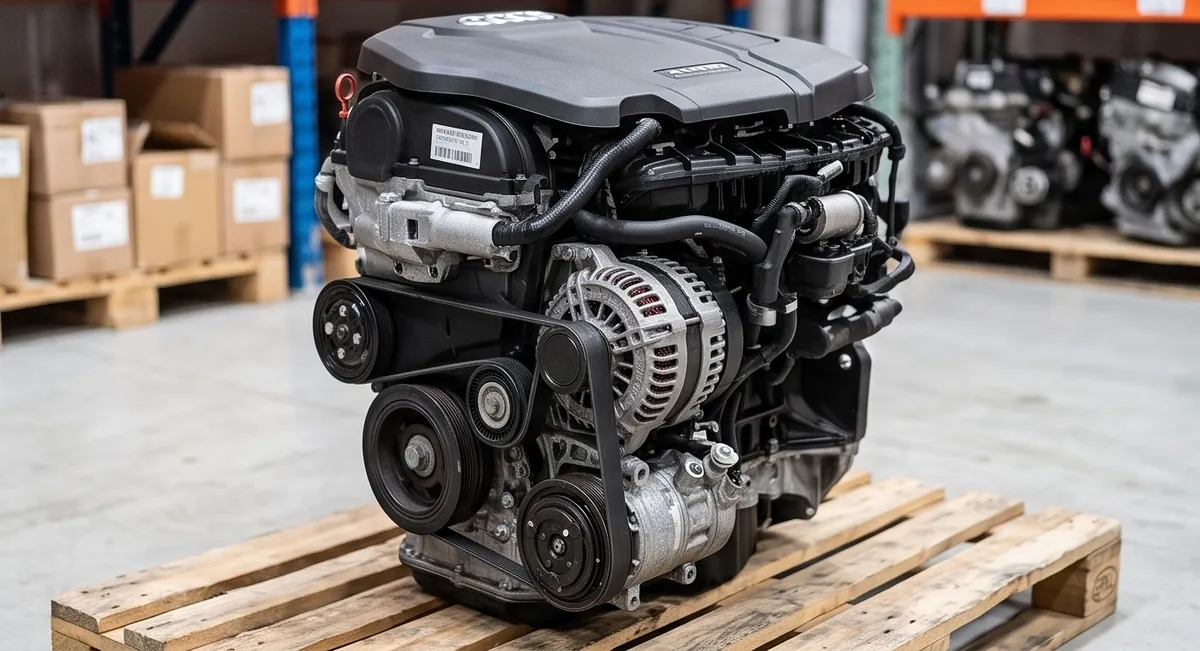
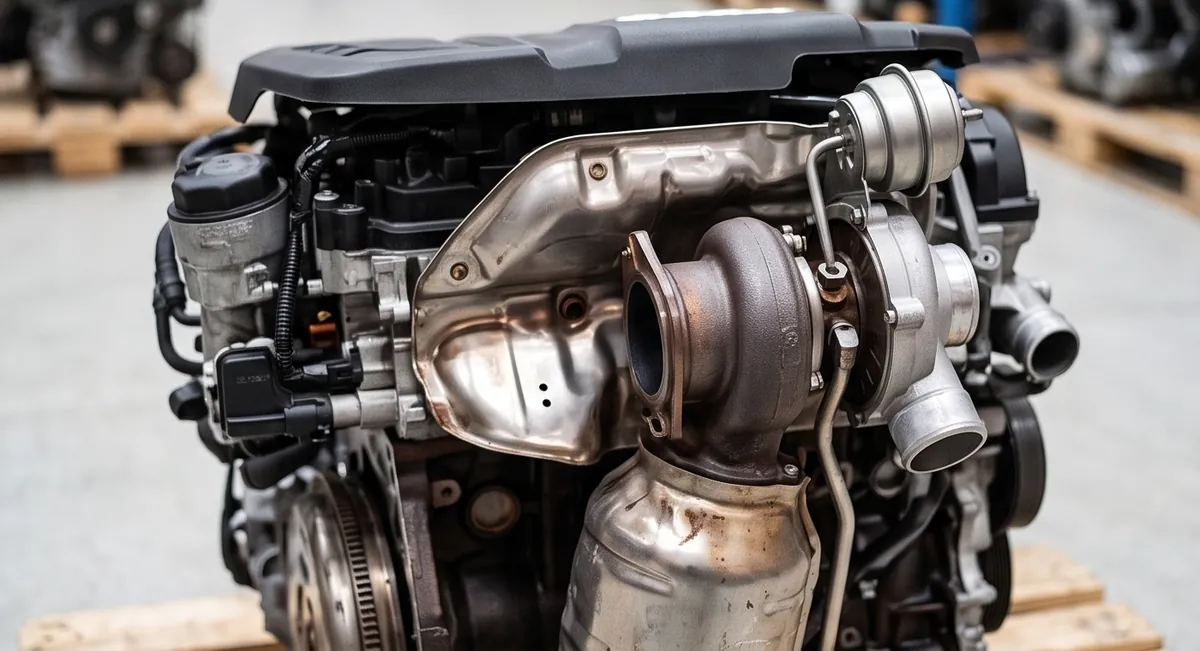
Audi A4 Engine for Sale | OEM Used Legendary 2.0L EA888 TFSI Turbocharged
$3,099.00
At a Glance
- Condition: OEM used, compression and leak-down tested all 4 cylinders
- Availability: In stock, Audi A4 2.0L EA888 TFSI engine available
- Shipping: Free shipping to all 50 states via heavy freight, 7 to 14 business days
- EA888 generation verified (Gen 1 / Gen 2 / Gen 3 / Gen 3B with critical mechanical differences across generations)
- A4 chassis generation confirmed (B7 2005-2008, B8 2009-2016, B9 2017 plus)
- Engine code documented (BWT / BPY / CAEB / CDNC / CPMA / CYFB / CYRB / CYNC / DLAA depending on generation and trim)
- Compression and leak-down tested all 4 cylinders
- Turbocharger condition assessed
- Direct injection system condition noted (HPDI high-pressure pump, fuel rail, injectors)
- Timing chain condition documented (CRITICAL: Gen 2 EA888 has documented timing chain tensioner failure issue)
- PCV system condition checked (known wear point causing oil consumption)
- Carbon buildup status on intake valves noted (direct injection engines are susceptible)
- Backed by a 15 day replacement warranty against internal defects
Description
About the Audi A4 EA888 TFSI Engine
Looking for a reliable replacement engine for your Audi A4? Part Nests stocks OEM used Audi A4 2.0L EA888 TFSI engines across multiple A4 chassis generations (B7 2005-2008, B8 2009-2016, B9 2017-current) and multiple EA888 engine family generations (Gen 1, Gen 2, Gen 3, Gen 3B). The EA888 is the legendary 2.0L turbocharged direct-injection inline-4 that has powered Audi A4 / A5 / A6 / Q3 / Q5 / TT plus Volkswagen Golf / GTI / Jetta / Passat / Tiguan / Atlas applications across the VAG (Volkswagen Audi Group) lineup since 2008. The EA888 is the successor to the EA113 turbocharged inline-4 family and has evolved through multiple generations with substantial mechanical changes (timing chain vs timing belt, oil pump architecture, fuel injection, ECU calibration), so identifying your specific generation is critical for ordering.
EA888 Engine Family Generation Overview
Critical for ordering: the EA888 family has evolved through four major generations with substantial mechanical differences. Specify your generation and engine code precisely.
EA888 Gen 1 (2008-2011):
- First-generation EA888, introduced in B8 A4 (2009-2010 model years)
- Engine codes: CAEB (211 HP A4), CDNC (208 HP A4), CDNB
- Timing CHAIN driven camshafts (NOT timing belt like the older EA113)
- Known issue: timing chain tensioner failure can cause catastrophic engine damage if chain slips
- Known issue: HIGH oil consumption due to piston ring design (later corrected in Gen 2 / Gen 3)
EA888 Gen 2 (2011-2013):
- Refined Gen 1 with improvements to address Gen 1 issues
- Engine codes: CPMA, CCTA, CCZA
- Updated piston rings to reduce oil consumption (though still some issues persist)
- Timing chain tensioner issue largely addressed but not eliminated
EA888 Gen 3 (2013-2019):
- Substantial redesign with improved efficiency and performance
- Engine codes: CYFB / CYRB / CYNC for Audi A4 B8 / B8.5 / B9 applications
- Audi Valvelift System (AVS) two-stage variable valve lift on intake
- Improved oil consumption characteristics
- Better fuel economy and lower emissions
EA888 Gen 3B (2019-current):
- Latest EA888 evolution with mild-hybrid 48V system integration on some applications
- Engine codes: DLAA / DLBA / DLHA
- Combined direct injection (FSI) plus port injection (MPI) on some variants to address carbon buildup issue
- Improved emissions for Tier 3 / Euro 6d compliance
Audi A4 Chassis Generations with EA888
The Audi A4 has used the EA888 across multiple chassis generations:
- B7 A4 (2005-2008): Used the predecessor EA113 turbocharged inline-4, NOT the EA888 (the EA888 was introduced for the B8)
- B8 A4 (2009-2016): EA888 Gen 1 / Gen 2 / Gen 3 across the model run, with Gen 1 in early years and Gen 3 in later B8 / B8.5 facelift years
- B9 A4 (2017-current): EA888 Gen 3 / Gen 3B across the model run, with Gen 3B introduced for 2019 plus model years with mild-hybrid 48V integration on some markets
Audi VAG Engine Family Context
The Audi A4 2.0L EA888 TFSI (this listing) is the smaller turbocharged inline-4 from the modern Audi lineup. For complete Audi engine family context across our catalog: the Audi RS3 2.5L TFSI (our listing, the legendary 5-cylinder TFSI turbocharged engine in the RS3 / TT RS / Q3 RS applications with the distinctive 5-cylinder engine sound and 400 HP plus output) is the high-performance Audi turbocharged engine using a different architecture (inline-5 vs inline-4). The Audi Q7 3.6L FSI V6 (our listing, the 3.6L FSI naturally-aspirated V6 in the Q7 4L 2007-2010 application) is the larger naturally-aspirated V6 architecture used in the original Q7 SUV. The Audi S4 4.2L V8 (our listing, the legendary 4.2 liter V8 producing 340 HP in the B6 / B7 S4 generation) is the large naturally-aspirated V8 used in the S4 / S5 V8 era before Audi moved to supercharged and turbocharged V6 / V8 for later S4 / S5 / RS4 / RS5 applications. Four Audi engine listings across our catalog: (this listing) the EA888 2.0L TFSI for A4 / A5 / Q5 applications, the 2.5L TFSI for RS3 / TT RS, the 3.6L FSI V6 for Q7 4L, the 4.2L V8 for S4. For Audi cooling system context, the Audi Q7 water pump (our listing, the belt-driven mechanical coolant pump for Audi Q7 chassis 4L 2006-2015 / 4M 2016 plus with engine variants 3.6L FSI VR6 / 3.0L TFSI Supercharged V6 / 4.2L FSI V8 / 4.2L TDI V8 / 3.0L TDI V6 / 2.0L TFSI Inline-4 / SQ7 4.0L variants, with documented plastic impeller failure pattern) is the related Audi cooling system listing showing that the EA888 2.0L TFSI (this listing) is also used in some 4M Q7 applications as the 2.0L TFSI Inline-4 variant per the listing.
EA888 Known Issues to Understand Before Buying
The EA888 has well-documented issues that buyers should understand. These are not deal-breakers but should inform your purchase decision and maintenance planning:
- Timing chain tensioner failure (Gen 1, partially addressed in Gen 2): The Gen 1 timing chain tensioner can fail catastrophically, causing the timing chain to slip and resulting in major engine damage (bent valves, piston damage). Audi issued multiple TSBs and recalls addressing this. By Gen 3 the tensioner design was substantially improved.
- High oil consumption (Gen 1, partially addressed in Gen 2, largely addressed in Gen 3): Gen 1 piston ring design caused excessive oil consumption (1 quart per 1,000-3,000 miles in many cases). Class action settlements compensated owners. Gen 3 substantially reduced consumption.
- PCV (positive crankcase ventilation) system failure: The PCV valve and diaphragm can fail, causing oil consumption, rough idle, and potential damage. The PCV is a common wear item requiring periodic replacement.
- Carbon buildup on intake valves: Direct injection engines spray fuel directly into the cylinder, bypassing the intake valves. Without fuel washing over the intake valves, carbon deposits accumulate from blow-by gases. Walnut shell blasting is the standard cleaning procedure (typically required every 60,000-100,000 miles). Gen 3B addresses this by adding port injection alongside the direct injection.
- Water pump failure: The EA888 uses a plastic-impeller water pump that can fail with age (similar to the broader Audi water pump issue documented). Upgraded metal-impeller water pumps are widely recommended.
- HPDI (high-pressure direct injection) pump failure: The high-pressure fuel pump cam follower can wear, causing inadequate fuel pressure.
Vehicle Compatibility
| Generation | Years | Key Features | Common A4 Engine Codes |
|---|---|---|---|
| EA888 Gen 1 | 2008-2011 | Original Audi 2.0 TFSI, B8 pre-facelift | CAEB (early B8) |
| EA888 Gen 2 | 2009-2013 | Refined Gen 1, used briefly | CDNC, CDNB |
| EA888 Gen 3 (THIS GEN) | 2013-2017 | Updated electronics, integrated exhaust manifold, mostly direct injection | CAED, CPMA (B8 facelift) |
| EA888 Gen 3B | 2016-2020 | Added port injection plus direct injection (combined system) | CYRB, CVKB (B9 early) |
| EA888 Gen 3C / Evo | 2018-Present | Further refined Gen 3B, Miller cycle on some variants | DLZ, DEZ (B9 later) |
EA888 Generation Specifications
| Engine Code | Generation | Years | Output | Notes |
|---|---|---|---|---|
| CAEB | Gen 1 | 2009-2013 | 211 HP / 258 lb-ft | Early B8 A4 2.0T |
| CDNC | Gen 1/2 | 2010-2013 | 211 HP / 258 lb-ft | Early B8 A4 2.0T variant |
| CAED | Gen 3 | 2013-2016 | 220 HP / 258 lb-ft | B8 facelift A4 2.0T |
| CPMA | Gen 3 | 2014-2016 | 220 HP / 258 lb-ft | B8 facelift quattro |
| CYRB | Gen 3B | 2017-2019 | 252 HP / 273 lb-ft | B9 A4 45 TFSI early |
| CVKB | Gen 3B | 2017-2019 | 252 HP / 273 lb-ft | B9 A4 quattro variant |
| DLZ | Gen 3B/3C | 2019-2022 | 261 HP / 273 lb-ft | B9 A4 45 TFSI refined |
| DEZ | Gen 3C | 2021-2024 | 261-292 HP / 273 lb-ft | B9 A4 with optional sport tune |
Engine Code Reference
| Vehicle | Compatibility |
|---|---|
| Audi A4 B8 Facelift | 2013-2016, EA888 Gen 3 (CAED / CPMA codes), 220 HP |
| Audi A4 B9 Early | 2017-2019, EA888 Gen 3B (CYRB / CVKB), 252 HP / 273 lb-ft |
| Audi A4 B9 Later | 2019-2022, EA888 Gen 3B/3C (DLZ), 261 HP / 273 lb-ft |
| Audi A4 B9 Latest | 2021-2024, EA888 Gen 3C (DEZ), 261-292 HP / 273 lb-ft |
Known Issues and Service Documentation
| Vehicle | Compatibility |
|---|---|
| Audi A5 (B8 / B9) | EA888 variants depending on year |
| Audi Q5 (first / second gen 2.0T) | EA888 variants |
| Audi A6 (some markets) | EA888 variants |
| Audi A3 / S3 | EA888 (S3 uses higher-output variant) |
| Audi TT | EA888 variants |
| Audi allroad | EA888 variants |
Common Audi A4 EA888 Failure Modes
| Vehicle | Compatibility |
|---|---|
| VW Golf GTI Mk7 / Mk7.5 / Mk8 | EA888 (220-241 HP depending on year) |
| VW Golf R Mk7 / Mk7.5 / Mk8 | EA888 higher output tune (288-315 HP) |
| VW Tiguan (second gen) | EA888 variants |
| VW Atlas / Atlas Cross Sport | EA888 variants |
| VW Jetta GLI | EA888 variants |
| VW Arteon | EA888 variants |
Why Buy From Part Nests
- EA888 generation verified (Gen 1 / Gen 2 / Gen 3 / Gen 3B critical mechanical differences across generations)
- A4 chassis generation confirmed (B7 used EA113 NOT EA888, B8 2009-2016, B9 2017 plus)
- Engine code documented (BWT / BPY / CAEB / CDNC / CPMA / CYFB / CYRB / CYNC / DLAA)
- Compression and leak-down tested all 4 cylinders
- Turbocharger condition assessed
- Direct injection HPDI system condition noted
- Timing chain condition documented (Gen 1 tensioner issue, Gen 2 partially addressed)
- PCV system condition checked
- Carbon buildup status on intake valves noted
- Honest disclosure of known issues (timing chain tensioner, oil consumption, PCV, carbon buildup)
- Free shipping to all 50 states via heavy freight
- 15 day replacement warranty on internal defects
- Audi / VAG-experienced support team familiar with EA888 across generations
- Call (855) 634-4447 for fitment confirmation and to lock in your order.
15 Day Replacement Warranty
Every used Audi A4 2.0L EA888 TFSI engine purchased through Part Nests carries a 15 day replacement warranty starting on the delivery date.
What Is Covered
- Internal defects already present when the engine arrives
- Compression failures on any of the 4 cylinders beyond what was disclosed
- Cylinder head crack failures within 15 days from installation
- Block crack failures within 15 days from installation
- Connecting rod, bearing, or crankshaft failures within 15 days from installation
- Turbocharger failures within 15 days from installation (where condition was documented as serviceable at shipping)
- HPDI high-pressure fuel pump failures within 15 days from installation (where supplied as functional)
- Direct injection injector failures within 15 days from installation (where supplied as functional)
- Timing chain failures within 15 days from installation (where chain and tensioner were documented as serviceable; Gen 1 tensioner issue is honestly disclosed before sale)
- Incorrect generation shipped (Gen 1 / Gen 2 / Gen 3 / Gen 3B mismatch where generation was documented) due to an error on our end
- Incorrect engine code shipped (CAEB / CDNC / CPMA / CYFB / CYRB / CYNC / DLAA mismatch where code was documented) due to an error on our end
What Is Not Covered
- Damage caused during installation
- Damage from incorrect engine oil (Audi / VAG specifies VW 502 00 / 504 00 approved 5W-40 or 0W-40 synthetic oil; using generic oil causes accelerated wear and may void warranty coverage)
- Damage from extended oil change intervals (Audi originally specified extended intervals but realistic maintenance recommends 5,000-7,500 mile changes especially for high-oil-consumption Gen 1 / Gen 2 engines)
- Damage from running with low oil (Gen 1 / Gen 2 engines consume oil and require frequent level checks; running low causes catastrophic damage)
- Damage from contaminated fuel (HPDI direct injection systems are particularly sensitive to fuel contamination)
- Damage from neglected fuel filter maintenance
- Damage from aftermarket performance modifications (Stage 1+ tunes increase boost and stress beyond OEM design; particularly damaging to Gen 1 / Gen 2 engines with known mechanical weak points)
- Damage from neglected carbon cleaning service (intake valve carbon buildup is an inherent direct-injection engine wear pattern; failure to address causes power loss and may damage valves)
- Damage from neglected PCV maintenance
- Damage from neglected water pump replacement (plastic-impeller water pumps are a known wear point)
- Damage from incorrect generation cross-application (EA888 generations have different mounting, sensor, and ECU integration; cross-application requires careful verification)
- External components (turbocharger if not supplied, intake manifold, exhaust manifold, ECU and wiring harness, accessory drive, transmission, AC compressor, alternator, starter, fuel tank, fuel lines outside the engine) unless itemized
- Labor expenses of any kind
To start a warranty claim, reach us within 15 days of delivery at (855) 634-4447.
- All 4 Cylinders Compression and Leak-Down Tested: Results documented before payment
- EA888 Generation Verified: Gen 1 / Gen 2 / Gen 3 / Gen 3B correctly identified
- A4 Chassis Generation Confirmed: B8 2009-2016 or B9 2017 plus (B7 used predecessor EA113)
- Engine Code Documented: Specific engine code for variant identification
- Timing Chain Tensioner Condition Documented: Gen 1 known issue honestly disclosed
- PCV System and Carbon Buildup Status Checked: Common wear points
- 15 Day Replacement Cover: Internal defects protected from delivery onward
Additional information
| Brand | Audi |
|---|---|
| engine-type | Inline 4-cylinder turbocharged petrol |
| engine-family | EA888 (Volkswagen Group modular family) |
| variants | EA888 Gen 1 / Gen 2 / Gen 3 / Gen 3B / Gen 3C |
| horsepower | 220 to 292 HP depending on generation and tune |
| displacement | 2.0 liters (1, 984 cc) |
| torque | 258 to 273 lb-ft typical |
| bore-x-stroke | 82.5 mm x 92.8 mm |
| compression-ratio | 9.6:1 (Gen 3) to 11.7:1 (Gen 3B Miller cycle variants) |
| aspiration | Single twin-scroll turbocharger with intercooling |
| fuel-system | Direct injection FSI (Gen 3); combined direct plus port injection (Gen 3B / 3C) |
| fuel-type | Premium Gasoline (91 octane minimum, 93 recommended) |
| valvetrain | DOHC, 16 valves, variable valve timing, Audi Valvelift System (AVS) on some variants |
| block-head-material | Cast iron block (most variants), aluminum cylinder head |
| manufacturer | Audi AG (Volkswagen Group) |
| production-years | 2008 to present (EA888 family); A4-specific variants 2013 to present |
| compatibility | Audi A4 (B8 facelift / B9), Audi Q5, Audi A5, plus VW Golf GTI / Golf R / Tiguan / Atlas / Jetta GLI |
| price | $3, 099.00 |
Legendary 2.0L turbocharged direct-injection inline-4 across the VAG lineup since 2008. The Audi A4 2.0L EA888 TFSI is the legendary 2.0L turbocharged direct-injection inline-4 that has powered Audi A4 / A5 / A6 / Q3 / Q5 / TT plus Volkswagen Golf / GTI / Jetta / Passat / Tiguan / Atlas applications across the VAG (Volkswagen Audi Group) lineup since 2008. The EA888 is the successor to the EA113 turbocharged inline-4 family and has evolved through multiple generations with substantial mechanical changes (timing chain vs timing belt, oil pump architecture, fuel injection, ECU calibration). Specifications: 2.0 liters displacement, turbocharged inline-4, direct injection (FSI / TFSI; later Gen 3B adds port injection MPI alongside direct injection), aluminum block and head, DOHC with 4 valves per cylinder, variable valve timing, Audi Valvelift System (AVS) on Gen 3 plus, multiple horsepower ratings depending on application and generation (211 HP base A4 to 292 HP RS-trim variants).
Four major generations with substantial mechanical differences across 2008-current. Critical for ordering: identify your specific generation. EA888 Gen 1 (2008-2011): introduced in B8 A4 (2009-2010 model years), engine codes CAEB / CDNC / CDNB, timing CHAIN driven (NOT timing belt like older EA113), known issues with timing chain tensioner failure and high oil consumption. EA888 Gen 2 (2011-2013): refined Gen 1, engine codes CPMA / CCTA / CCZA, updated piston rings to reduce oil consumption, timing chain tensioner issue largely addressed. EA888 Gen 3 (2013-2019): substantial redesign, engine codes CYFB / CYRB / CYNC for Audi A4 B8 / B8.5 / B9 applications, Audi Valvelift System (AVS) two-stage variable valve lift on intake, improved oil consumption. EA888 Gen 3B (2019-current): latest EA888 evolution, engine codes DLAA / DLBA / DLHA, mild-hybrid 48V system integration on some applications, combined direct injection (FSI) plus port injection (MPI) on some variants to address carbon buildup issue.
B8 (2009-2016) and B9 (2017 plus). NOT the B7 which used the EA113. The Audi A4 has used the EA888 across multiple chassis generations. B7 A4 (2005-2008): used the predecessor EA113 turbocharged inline-4, NOT the EA888 (the EA888 was introduced for the B8). B8 A4 (2009-2016): EA888 Gen 1 / Gen 2 / Gen 3 across the model run, with Gen 1 in early years and Gen 3 in later B8 / B8.5 facelift years. B9 A4 (2017-current): EA888 Gen 3 / Gen 3B across the model run, with Gen 3B introduced for 2019 plus model years with mild-hybrid 48V integration on some markets. The EA888 was also used extensively across Audi A5 / Q5 / A6 / Q3 and TT applications, plus Volkswagen Golf / GTI / Jetta / Passat / Tiguan / Atlas applications, making it one of the most widely-produced engines in the VAG lineup.
Multiple well-documented issues across generations. Timing chain tensioner failure (Gen 1, partially addressed in Gen 2): the Gen 1 timing chain tensioner can fail catastrophically, causing the timing chain to slip and resulting in major engine damage (bent valves, piston damage). Audi issued multiple TSBs and recalls. By Gen 3 the tensioner design was substantially improved. High oil consumption (Gen 1, partially addressed in Gen 2, largely addressed in Gen 3): Gen 1 piston ring design caused excessive oil consumption (1 quart per 1,000-3,000 miles). Class action settlements compensated owners. PCV system failure: the PCV valve and diaphragm can fail, causing oil consumption and rough idle. Carbon buildup on intake valves: direct injection engines accumulate carbon on intake valves; walnut shell blasting is the standard cleaning procedure required every 60,000-100,000 miles. Gen 3B addresses this with port injection. Water pump failure: plastic-impeller water pumps can fail (similar to broader Audi water pump issue). HPDI pump cam follower wear.
Multiple Audi engines across our catalog. The Audi A4 2.0L EA888 TFSI (this listing) is the smaller turbocharged inline-4 from the modern Audi lineup. The Audi RS3 2.5L TFSI is the legendary 5-cylinder TFSI turbocharged engine in the RS3 / TT RS / Q3 RS applications (distinctive 5-cylinder engine sound, 400 HP plus output). The Audi Q7 3.6L FSI V6 is the 3.6L FSI naturally-aspirated V6 in the Q7 4L 2007-2010 application (the larger naturally-aspirated V6 architecture used in the original Q7 SUV). The Audi S4 4.2L V8 is the legendary 4.2 liter V8 producing 340 HP in the B6 / B7 S4 generation (the large naturally-aspirated V8 used in the S4 / S5 V8 era before Audi moved to supercharged and turbocharged V6 / V8 for later S-trim applications). Four Audi engine listings across : (this listing) EA888 2.0L TFSI for A4 / A5 / Q5, 2.5L TFSI for RS3 / TT RS, 3.6L FSI V6 for Q7 4L, 4.2L V8 for S4. Plus the Audi Q7 water pump from the related cooling system listing.
VW 502 00 / 504 00 approved 5W-40 or 0W-40 synthetic. Audi / VAG specifies VW 502 00 / 504 00 approved 5W-40 or 0W-40 synthetic oil for the EA888. Using generic oil causes accelerated wear and may void warranty coverage. The 502 00 / 504 00 specification ensures the correct viscosity, additive package, and ash content for the TFSI direct-injection engine. Recommended brands include Mobil 1, Castrol Edge, Liqui Moly Top Tec, and Pentosin. Audi originally specified extended oil change intervals (up to 10,000 miles) but realistic maintenance recommends 5,000-7,500 mile changes especially for high-oil-consumption Gen 1 / Gen 2 engines. Frequent level checks are essential for Gen 1 / Gen 2 engines due to the documented oil consumption issue. Running low on oil causes catastrophic damage to bearings and turbocharger.
Yes, every 60,000-100,000 miles via walnut shell blasting. Direct injection engines spray fuel directly into the cylinder, bypassing the intake valves. Without fuel washing over the intake valves, carbon deposits accumulate from blow-by gases. This is an inherent characteristic of direct-injection engines and not unique to the EA888. Walnut shell blasting is the standard cleaning procedure (typically required every 60,000-100,000 miles depending on driving conditions). Symptoms of carbon buildup: misfires, reduced power, rough running, check engine light. The Gen 3B variant addresses this issue by adding port injection alongside the direct injection, allowing fuel to wash over the intake valves and prevent carbon accumulation. For Gen 1 / Gen 2 / Gen 3 owners, proactive carbon cleaning is essential preventive maintenance. Cost is typically $500-1,200 at a specialist shop.
No. There is no core return required.
2 reviews for Audi A4 Engine for Sale | OEM Used Legendary 2.0L EA888 TFSI Turbocharged
Related products




Theodore P. –
Got the part for my Audi A4 Engine. Simple process end to end.
Hyacinth M. –
Bolted up to the Audi A4 Engine clean. Nothing to complain about.