

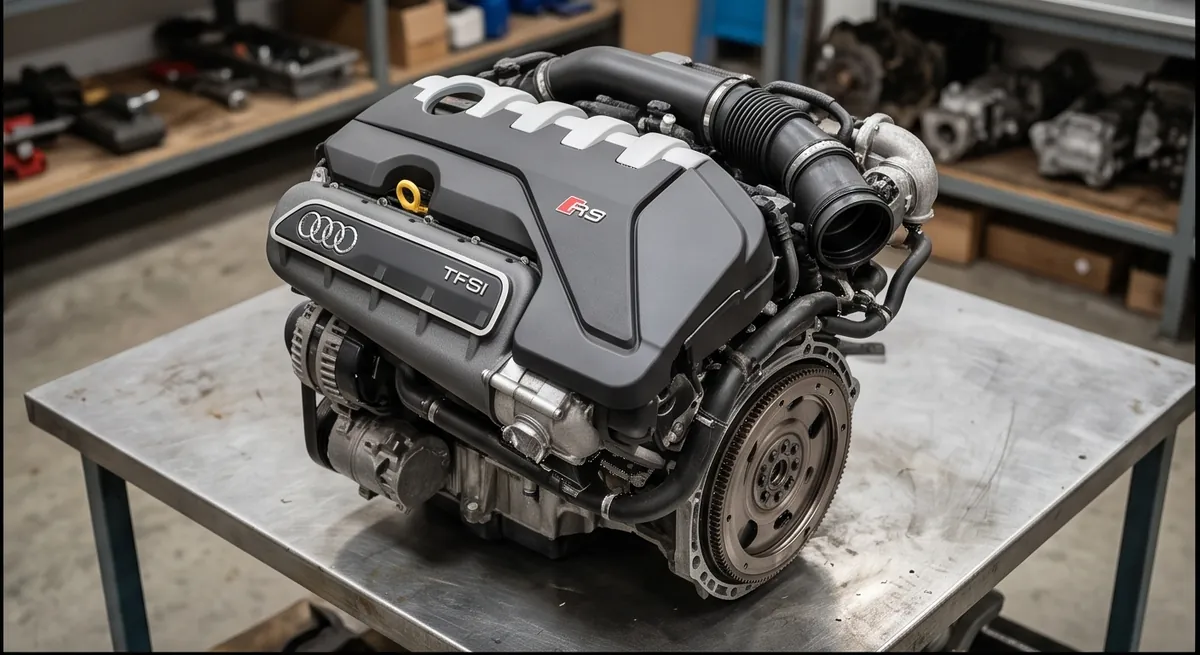
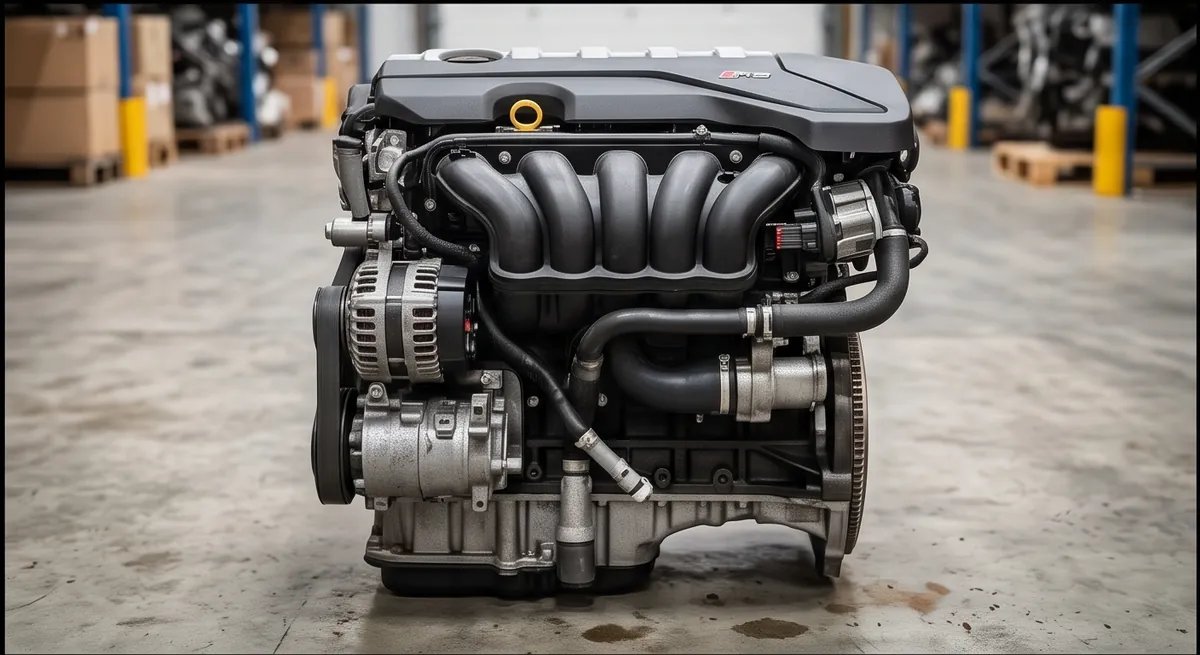
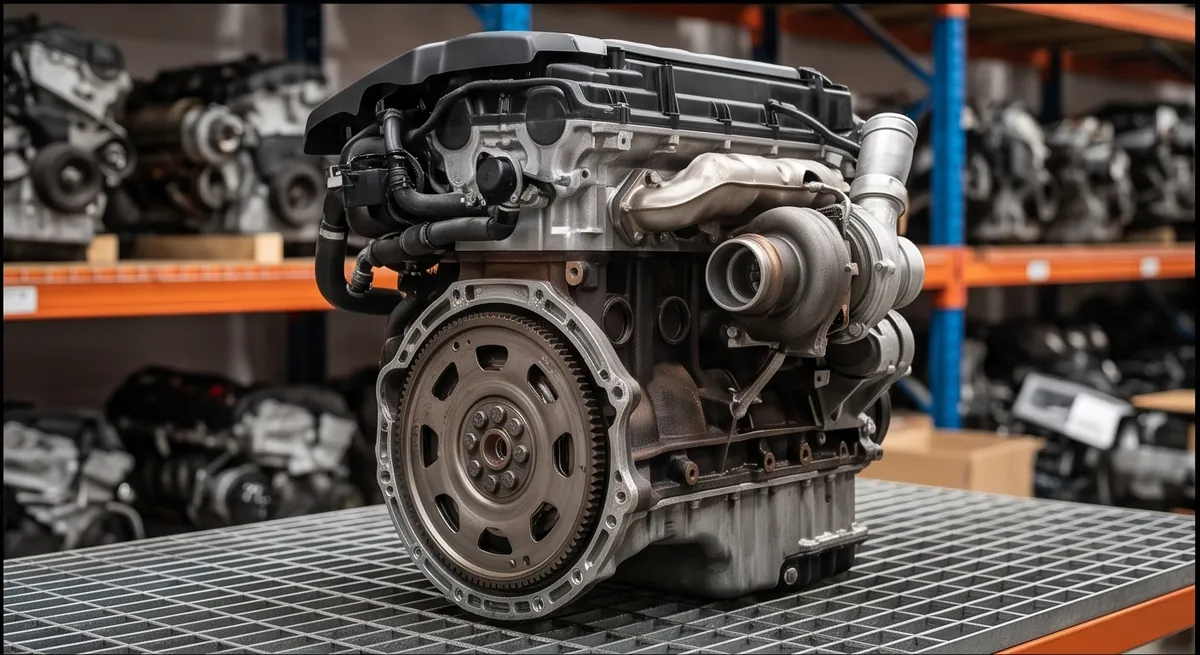
Audi RS3 Engine for Sale | OEM Used Legendary 2.5L TFSI Turbocharged Inline-5
$9,999.00
At a Glance
- Condition: OEM used, compression and leak-down tested all 5 cylinders
- Availability: In stock, Audi RS3 2.5L TFSI inline-5 engine available
- Shipping: Free shipping to all 50 states via heavy freight, 7 to 14 business days
- Engine code verified (CEPA / CEPB / CZGB / DAZA / DNWA depending on generation and trim)
- Generation confirmed (Gen 1 8P / 8V early, Gen 2 8V facelift, Gen 3 8Y with revised internals)
- Application confirmed (RS3 8P / 8V / 8Y, TT RS 8J / 8S, RSQ3 F3, etc.)
- Horsepower rating documented (340-401 HP range depending on variant)
- Compression and leak-down tested all 5 cylinders
- Turbocharger condition assessed
- Direct injection HPDI system condition noted (later variants add port injection MPI)
- Distinctive 1-2-4-5-3 firing order architecture preserved
- Backed by a 15 day replacement warranty against internal defects
Description
About the Audi RS3 2.5L TFSI Engine
Looking for the legendary Audi 2.5L TFSI inline-5 cylinder engine for your RS3, TT RS, or RSQ3 project? Part Nests stocks OEM used Audi 2.5 TFSI engines across the multiple generations of this distinctive engine family. The 2.5 TFSI is the modern descendant of Audi long heritage of inline-5 cylinder engines (going back to the original Audi 200 turbo and the legendary Quattro rally cars of the 1980s) and represents the only 5-cylinder engine currently in production from any major manufacturer. With outputs ranging from 340 HP to 401 HP depending on generation and application, the 2.5 TFSI is universally praised for its distinctive 5-cylinder exhaust note (the unmistakable 1-2-4-5-3 firing-order growl) and exceptional turbocharged performance. Whether you are restoring an RS3 8P, building a TT RS 8J, completing an RS3 8V refresh, or sourcing for the latest RS3 8Y or RSQ3 F3 application, this listing covers the Audi 2.5 TFSI across generations.
Engine Overview: The 2.5 TFSI Inline-5 Architecture
The Audi 2.5 TFSI is a 2.5 liter (2,480 cc) turbocharged direct-injection inline-5 cylinder engine. Specifications:
- Displacement: 2.5 liters (2,480 cc)
- Configuration: Inline-5 cylinder turbocharged
- Aspiration: Single turbocharger (BorgWarner K16 or similar depending on variant)
- Fuel System: TFSI direct injection (FSI) with port injection (MPI) added on Gen 3 to address carbon buildup
- Bore x Stroke: 82.5 mm x 92.8 mm
- Power Output: 340-401 HP depending on generation and application
- Peak Torque: 332-369 lb-ft depending on variant
- Redline: Approximately 6,800 RPM
- Block Material: Cast iron block (Gen 1 / early Gen 2) or aluminum block (Gen 3 with revised internals)
- Head Material: Aluminum head
- Valve Train: DOHC with 4 valves per cylinder (20 valves total)
- Variable Valve Timing: On both intake and exhaust
- Firing Order: 1-2-4-5-3 (distinctive inline-5 firing pattern that creates the signature growl)
Why the 5-Cylinder Sound is Iconic
The Audi 2.5 TFSI inline-5 has become one of the most celebrated engines in modern performance car history specifically because of its sound. Understanding why is part of the appeal:
- Firing order 1-2-4-5-3: The inline-5 firing pattern creates an uneven firing interval (144 degrees between firings instead of 180 degrees for inline-4 or 120 degrees for V6), producing the distinctive growl
- Audi rally heritage: The Quattro rally cars of the early 1980s used inline-5 turbocharged engines and dominated WRC, embedding the 5-cylinder sound in performance car heritage
- Quattro / 5-cylinder identity: The combination of quattro all-wheel drive and inline-5 turbocharged engine is uniquely Audi
- Only production 5-cylinder: No other major manufacturer currently produces an inline-5 (Volvo and Mercedes-Benz had 5-cylinder engines but discontinued them years ago), making Audi the sole carrier of the 5-cylinder tradition
- Engine of the Year wins: The 2.5 TFSI has won the International Engine of the Year award in its category multiple times
Audi 2.5 TFSI Generation Overview
| Era | Vehicle | Engine | Significance |
|---|---|---|---|
| 1976-1980s | Audi 5000 (US) / 100 (Europe) | Naturally aspirated 5-cylinder | Audi’s introduction of the 5-cylinder concept |
| 1980-1991 | Audi Quattro | Turbocharged 5-cylinder (200 to 600 plus HP) | Revolutionized motorsport with turbo + Quattro AWD, won Group B rally championships |
| 1984-1987 | Audi Sport Quattro S1 (Group B) | Turbocharged 5-cylinder, 600 plus HP | Legendary Group B rally car |
| 1989-1994 | Audi S2 / RS2 | Turbocharged 5-cylinder | Continued 5-cylinder performance tradition |
| 2000s | (5-cylinder went on hiatus) | Various V6 / V8 | Audi focused on V engines |
| 2011-2012 | Audi RS3 8P | CEPA 2.5 TFSI inline-5 (340 HP) | Audi revives the 5-cylinder for the RS3 |
| 2013-2016 | Audi RS3 8V pre-facelift / TT RS 8S early | CZGB / CTSA 2.5 TFSI (367 HP) | Improved 5-cylinder, still cast iron block |
| 2017-2020 | Audi RS3 8V.5 (THIS LISTING) | DAZA 2.5 TFSI EVO (400 HP) | Aluminum block EVO engine |
| 2021-Present | Audi RS3 8Y (THIS LISTING) | DNWA 2.5 TFSI EVO (401 HP) | Latest EVO with revised tuning |
Applications Across the Audi Lineup
The 2.5 TFSI has powered multiple Audi performance applications:
- RS3 8P (2011-2013): First-generation RS3 hatchback, 340 HP
- RS3 8V (2015-2020): Second-generation RS3 hatchback and Sportback / Sedan variants, 367-394 HP across the model run
- RS3 8Y (2022 plus): Third-generation RS3 hatchback / Sedan, 401 HP, with revised internals and improved torque vectoring
- TT RS 8J (2009-2014): First-generation TT RS, 340-360 HP
- TT RS 8S (2016-2022): Second-generation TT RS coupe / roadster, 394 HP
- RSQ3 8U (2013-2018): First-generation RSQ3 compact SUV, 310-340 HP
- RSQ3 F3 (2019-current): Second-generation RSQ3 and RSQ3 Sportback, 394 HP
Audi VAG Engine Family Context
The Audi RS3 2.5L TFSI inline-5 (this listing) is the legendary inline-5 cylinder TFSI turbocharged engine that occupies a unique position in the Audi lineup as the only 5-cylinder engine in current production. For complete Audi engine family context across our catalog: the Audi A4 2.0L EA888 TFSI (our listing, the modern 2.0L turbocharged direct-injection inline-4 across Gen 1 / Gen 2 / Gen 3 / Gen 3B generations for A4 / A5 / Q5 applications) is the smaller turbocharged inline-4 used across the broader Audi lineup for standard A4 / A5 / Q5 applications. The Audi Q7 3.6L FSI V6 (our listing, the 3.6L FSI naturally-aspirated V6 in the Q7 4L 2007-2010 application) is the larger naturally-aspirated V6 used in the original Q7 SUV. The Audi S4 4.2L V8 (our listing, the legendary 4.2 liter V8 producing 340 HP in the B6 / B7 S4 generation) is the large naturally-aspirated V8 used in the V8 S4 era. Four Audi engine listings across : EA888 2.0L TFSI inline-4 for standard A4 applications, (this listing) 2.5L TFSI inline-5 for RS3 / TT RS / RSQ3 high-performance applications, 3.6L FSI V6 for Q7 4L, 4.2L V8 for V8 S4. Each engine represents a different performance tier and architecture in the Audi lineup. For Audi cooling system context, the Audi Q7 water pump (our listing, the belt-driven mechanical coolant pump for Audi Q7 chassis 4L 2006-2015 / 4M 2016 plus across multiple engine variants) is the related Audi cooling system listing.
Known Issues and Service Considerations
- Carbon buildup on intake valves (Gen 1 / Gen 2): Direct injection engines accumulate carbon on intake valves; the 2.5 TFSI is no exception. Walnut shell blasting every 60,000-100,000 miles is standard preventive maintenance. Gen 3 (2.5 TFSI with port injection MPI alongside direct injection FSI) addresses this issue.
- Turbocharger oil starvation if oil maintenance neglected: The single turbocharger is critical to engine operation; extended oil change intervals or low oil level cause turbo bearing failure.
- HPDI fuel pump cam follower wear: Similar to other VAG direct-injection engines.
- Water pump failure: Plastic-impeller water pump can fail (similar to broader Audi water pump issue documented in).
- Cooling system stress at sustained high output: The 2.5 TFSI is producing significant power from compact displacement; cooling system maintenance is critical for sustained track use.
Vehicle Compatibility
| Feature | CEPA / CTSA / CZGB (2011-2016) | DAZA / DNWA EVO (2017-Present) |
|---|---|---|
| Block Material | Cast iron | Aluminum (cast-in iron liners) |
| Weight | Approximately 173 kg | Approximately 147 kg (26 kg / 57 lbs lighter) |
| Output | 340 HP (CEPA) to 367 HP (CTSA) | 400 HP (DAZA), 401 HP (DNWA) |
| Torque | 332-343 lb-ft | 354 lb-ft |
| Firing Order | Traditional 5-cyl | Revised 1-2-4-5-3 for improved acoustics |
| Compression | 10.0:1 | 10.0:1 |
| Bore x Stroke | 82.5 x 92.8 mm | 82.5 x 92.8 mm (same) |
Engine Code Reference and Application Mapping
| Model | Engine Code | Years | Output | Notes |
|---|---|---|---|---|
| Audi RS3 8V.5 (Sedan / Sportback) | DAZA | 2017-2020 | 400 HP / 354 lb-ft | First aluminum block 2.5 TFSI |
| Audi RS3 8Y (Sedan / Sportback) | DNWA | 2021-Present | 401 HP / 369 lb-ft (some markets) | Refined DAZA with revised electronics |
| Audi TT RS 8S | DAZA / DNWA | 2016-2022 | 400 HP / 354 lb-ft | Coupe / Roadster body, same engine |
| Audi RS Q3 | DAZA / DNWA | 2020-Present | 400 HP / 354 lb-ft | SUV body with same 2.5 TFSI |
Generation Specifications
| Vehicle | Compatibility |
|---|---|
| Audi RS3 8V.5 Facelift Sedan / Sportback | 2017-2020 production with DAZA engine code, 400 HP / 354 lb-ft |
| Audi RS3 8Y Sedan / Sportback | 2021-present with DNWA engine code, 401 HP / 369 lb-ft (some markets) |
| Audi TT RS 8S Coupe / Roadster | 2016-2022 with DAZA (early) and DNWA (late) engines, same 400 HP rating |
| Audi RS Q3 | 2020-present with DAZA / DNWA, 400 HP / 354 lb-ft, SUV body |
Common Failure Modes and Service Documentation
| Vehicle | Compatibility |
|---|---|
| Audi RS3 8P (2011-2012) | Uses CEPA engine (340 HP, cast iron block), earlier 5-cylinder generation, NOT the EVO |
| Audi RS3 8V Pre-Facelift / TT RS Early 8J | Uses CTSA / CZGB engines (367 HP, cast iron block), predecessor to EVO |
Why Buy From Part Nests
- Engine code verified (CEPA / CEPB / CZGB / DAZA / DNWA)
- Generation confirmed (Gen 1 / Gen 2 facelift / Gen 3 with revised internals)
- Application confirmed (RS3 8P / 8V / 8Y, TT RS 8J / 8S, RSQ3 8U / F3)
- Horsepower rating documented (340-401 HP range)
- Compression and leak-down tested all 5 cylinders
- Turbocharger condition assessed
- Direct injection HPDI system condition noted (later variants add port injection MPI)
- Distinctive 1-2-4-5-3 firing order architecture preserved
- Honest disclosure of known issues
- Free shipping to all 50 states via heavy freight
- 15 day replacement warranty on internal defects
- Audi performance experienced support team familiar with the 2.5 TFSI across generations
- Call (855) 634-4447 to confirm fit and availability before ordering.
15 Day Replacement Warranty
Every used Audi RS3 / TT RS / RSQ3 2.5L TFSI engine purchased through Part Nests carries a 15 day replacement warranty starting on the delivery date.
What Is Covered
- Internal defects already present when the engine arrives
- Compression failures on any of the 5 cylinders beyond what was disclosed
- Cylinder head crack failures within 15 days from installation
- Block crack failures within 15 days from installation
- Connecting rod, bearing, or crankshaft failures within 15 days from installation
- Turbocharger failures within 15 days from installation (where condition was documented as serviceable at shipping)
- HPDI high-pressure fuel pump failures within 15 days from installation (where supplied as functional)
- Direct injection injector failures within 15 days from installation (where supplied as functional)
- Timing chain failures within 15 days from installation
- Incorrect generation shipped (Gen 1 / Gen 2 / Gen 3 mismatch where generation was documented) due to an error on our end
- Incorrect engine code shipped (CEPA / CEPB / CZGB / DAZA / DNWA mismatch where code was documented) due to an error on our end
What Is Not Covered
- Damage caused during installation
- Damage from incorrect engine oil (Audi specifies VW 502 00 / 504 00 approved 5W-40 synthetic oil)
- Damage from extended oil change intervals (5,000-7,500 mile changes recommended for high-output applications)
- Damage from running with low oil (high-output turbocharged engines are particularly sensitive to oil starvation)
- Damage from contaminated fuel
- Damage from aftermarket performance modifications (Stage 1+ tunes push the 2.5 TFSI beyond OEM design and can damage internals, particularly Gen 1 / Gen 2 cast iron block variants)
- Damage from sustained track use beyond cooling system capacity
- Damage from neglected carbon cleaning service (intake valve carbon buildup on Gen 1 / Gen 2 is an inherent direct-injection engine wear pattern)
- Damage from neglected water pump replacement (plastic-impeller water pumps are a known wear point)
- Damage from incorrect generation cross-application (Gen 1 cast iron block vs Gen 3 aluminum block have different mounting and integration)
- External components (turbocharger if not supplied, intake manifold, exhaust manifold, ECU and wiring harness, accessory drive, transmission, AC compressor, alternator, starter, fuel tank, fuel lines outside the engine) unless itemized
- Labor expenses of any kind (Audi specialist labor rates apply for proper installation and tuning)
To start a warranty claim, reach us within 15 days of delivery at (855) 634-4447.
- All 5 Cylinders Compression and Leak-Down Tested: Results documented before payment
- Engine Code Verified: CEPA / CEPB / CZGB / DAZA / DNWA correctly identified
- Generation Confirmed: Gen 1 / Gen 2 facelift / Gen 3 with revised internals
- Application Confirmed: RS3 / TT RS / RSQ3 across chassis variants
- Horsepower Rating Documented: 340-401 HP range across variants
- Turbocharger Condition Assessed: BorgWarner K16 or similar
- Distinctive 1-2-4-5-3 Firing Order Preserved: The iconic 5-cylinder sound architecture
- 15 Day Replacement Cover: Internal defects protected from delivery onward
Additional information
| Brand | Audi |
|---|---|
| engine-type | Inline 5-cylinder turbocharged petrol |
| engine-family | Audi 2.5 TFSI inline-5 (EA855 evo) |
| engine-codes | DAZA (2017-2020) and DNWA (2021-present) |
| horsepower | 400 HP (DAZA) to 401 HP (DNWA) |
| displacement | 2.5 liters (2, 480 cc / 151 cubic inches) |
| bore-x-stroke | 82.5 mm x 92.8 mm |
| compression-ratio | 10.0:1 |
| torque | 354 lb-ft (DAZA), 354-369 lb-ft (DNWA depending on market) |
| aspiration | Single twin-scroll turbocharger with intercooling |
| fuel-system | Direct injection FSI (some markets add port injection) |
| fuel-type | Premium Gasoline (93 octane recommended) |
| valvetrain | DOHC, 20 valves total, variable valve timing, Audi Valvelift System (AVS) |
| firing-order | 1-2-4-5-3 (distinctive EVO firing pattern) |
| block-head-material | Aluminum block with cast-in iron liners (EVO upgrade from earlier cast iron), aluminum cylinder head |
| manufacturer | Audi AG (Györ Engine Plant, Hungary) |
| redline | 7, 000 RPM |
| production-years | 2017 to present (EVO variants) |
| compatibility | Audi RS3 8V.5 / 8Y, Audi TT RS 8S, Audi RS Q3 |
| historical-significance | Continuation of Audi Quattro 5-cylinder heritage; multiple International Engine of the Year wins |
Legendary turbocharged inline-5 cylinder engine. The Audi 2.5L TFSI is the legendary turbocharged direct-injection inline-5 cylinder engine that has powered RS3 / TT RS / RSQ3 applications since 2009. The 2.5 TFSI is the modern descendant of Audi long heritage of inline-5 cylinder engines (going back to the original Audi 200 turbo and the legendary Quattro rally cars of the 1980s) and represents the only 5-cylinder engine currently in production from any major manufacturer. Specifications: 2.5 liters displacement (2,480 cc), inline-5 cylinder turbocharged, single turbocharger (BorgWarner K16 or similar), TFSI direct injection (FSI) with port injection (MPI) added on Gen 3, 340-401 HP depending on generation and application, 332-369 lb-ft peak torque, approximately 6,800 RPM redline, cast iron block (Gen 1 / early Gen 2) or aluminum block (Gen 3 with revised internals), aluminum head, DOHC with 4 valves per cylinder, variable valve timing, firing order 1-2-4-5-3 (distinctive inline-5 firing pattern that creates the signature growl).
Firing order 1-2-4-5-3 with uneven firing intervals creates the distinctive growl. The Audi 2.5 TFSI inline-5 has become one of the most celebrated engines in modern performance car history specifically because of its sound. Firing order 1-2-4-5-3: the inline-5 firing pattern creates an uneven firing interval (144 degrees between firings instead of 180 degrees for inline-4 or 120 degrees for V6), producing the distinctive growl. Audi rally heritage: the Quattro rally cars of the early 1980s used inline-5 turbocharged engines and dominated WRC, embedding the 5-cylinder sound in performance car heritage. Quattro / 5-cylinder identity: the combination of quattro all-wheel drive and inline-5 turbocharged engine is uniquely Audi. Only production 5-cylinder: no other major manufacturer currently produces an inline-5 (Volvo and Mercedes-Benz had 5-cylinder engines but discontinued them years ago), making Audi the sole carrier of the 5-cylinder tradition. Engine of the Year wins: the 2.5 TFSI has won the International Engine of the Year award in its category multiple times.
RS3, TT RS, and RSQ3 across multiple generations. The 2.5 TFSI has powered multiple Audi performance applications: RS3 8P (2011-2013, first-generation RS3 hatchback, 340 HP), RS3 8V (2015-2020, second-generation RS3 hatchback and Sportback / Sedan variants, 367-394 HP across the model run), RS3 8Y (2022 plus, third-generation RS3 hatchback / Sedan, 401 HP, with revised internals and improved torque vectoring), TT RS 8J (2009-2014, first-generation TT RS, 340-360 HP), TT RS 8S (2016-2022, second-generation TT RS coupe / roadster, 394 HP), RSQ3 8U (2013-2018, first-generation RSQ3 compact SUV, 310-340 HP), RSQ3 F3 (2019-current, second-generation RSQ3 and RSQ3 Sportback, 394 HP). The 2.5 TFSI is exclusive to Audi's RS-trim performance applications and is not used in standard A4 / A5 / Q5 trims (those use the EA888 2.0L TFSI).
Three major generations with substantial mechanical differences. Critical for ordering: identify your generation and engine code. Gen 1 (2009-2014, for RS3 8P / TT RS 8J / early RSQ3 8U): engine codes CEPA / CEPB, cast iron block, single direct injection (FSI only), 340-360 HP base, the original architecture introduced for the TT RS 8J. Gen 2 (2015-2020 facelift, for RS3 8V / TT RS 8S / RSQ3 8U facelift): refined Gen 1, engine codes CZGB / DAZA, refinements to address Gen 1 issues, 367-394 HP, transitioning from cast iron block to aluminum block partway through the production run. Gen 3 (2022 plus, for RS3 8Y / RSQ3 F3): substantial redesign, engine code DNWA, aluminum block (lighter), revised internals, combined direct injection (FSI) plus port injection (MPI) to address carbon buildup, 401 HP.
Four Audi engine listings in plus. The Audi RS3 2.5L TFSI inline-5 (this listing) is the legendary inline-5 cylinder TFSI turbocharged engine that occupies a unique position in the Audi lineup as the only 5-cylinder engine in current production. The Audi A4 2.0L EA888 TFSI is the modern 2.0L turbocharged direct-injection inline-4 across Gen 1 / Gen 2 / Gen 3 / Gen 3B generations for A4 / A5 / Q5 applications (the smaller turbocharged inline-4 used across the broader Audi lineup). The Audi Q7 3.6L FSI V6 is the 3.6L FSI naturally-aspirated V6 in the Q7 4L 2007-2010 application (the larger naturally-aspirated V6 used in the original Q7 SUV). The Audi S4 4.2L V8 is the legendary 4.2 liter V8 producing 340 HP in the B6 / B7 S4 generation (the large naturally-aspirated V8 used in the V8 S4 era). Each engine represents a different performance tier and architecture: 2.0L EA888 inline-4 for standard, 2.5L TFSI inline-5 for RS3 / TT RS / RSQ3 high-performance, 3.6L FSI V6 for Q7 4L luxury SUV, 4.2L V8 for the V8 S4 era. Plus the Audi Q7 water pump from the related cooling system listing.
Five well-documented issues. Carbon buildup on intake valves (Gen 1 / Gen 2): direct injection engines accumulate carbon on intake valves; the 2.5 TFSI is no exception. Walnut shell blasting every 60,000-100,000 miles is standard preventive maintenance. Gen 3 (with port injection MPI alongside direct injection FSI) addresses this issue. Turbocharger oil starvation if oil maintenance neglected: the single turbocharger is critical to engine operation; extended oil change intervals or low oil level cause turbo bearing failure. HPDI fuel pump cam follower wear: similar to other VAG direct-injection engines. Water pump failure: plastic-impeller water pump can fail (similar to broader Audi water pump issue documented in). Cooling system stress at sustained high output: the 2.5 TFSI is producing significant power from compact displacement; cooling system maintenance is critical for sustained track use.
Different architecture, different application tier. The 2.5 TFSI (this listing) and the EA888 2.0L are both modern Audi turbocharged direct-injection engines, but serve different roles. The EA888 2.0L is the volume-production engine used across standard A4 / A5 / Q5 / Q3 applications (plus Volkswagen Golf / GTI / Jetta / Passat / Tiguan / Atlas) with 211-292 HP across variants and Gen 1 / Gen 2 / Gen 3 / Gen 3B generations. The 2.5 TFSI is the high-performance exclusive engine for RS-trim applications (RS3 / TT RS / RSQ3) with 340-401 HP and the distinctive inline-5 architecture. The EA888 is a 4-cylinder; the 2.5 TFSI is a 5-cylinder. The EA888 typically uses a smaller turbocharger; the 2.5 TFSI uses a larger turbocharger for the higher output. The EA888 has documented timing chain tensioner issues (Gen 1) and oil consumption (Gen 1 / Gen 2); the 2.5 TFSI has its own carbon buildup and water pump issues. Different engines for different applications, both legendary in their respective tiers.
No. There is no core return required.
2 reviews for Audi RS3 Engine for Sale | OEM Used Legendary 2.5L TFSI Turbocharged Inline-5
Related products



Recently Viewed Products



Persephone L. –
Ordered for an Audi RS3 Engine swap. Painless from quote to delivery.
Cassius J. –
Slotted right into my Audi RS3 Engine. No wasted time.