
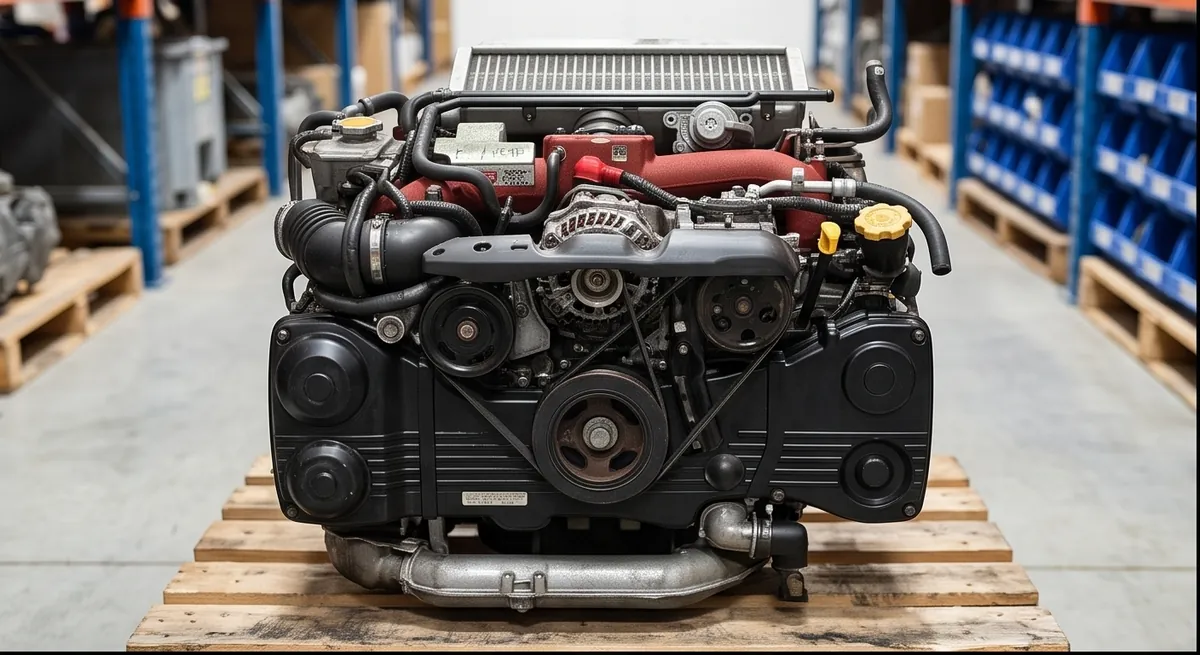
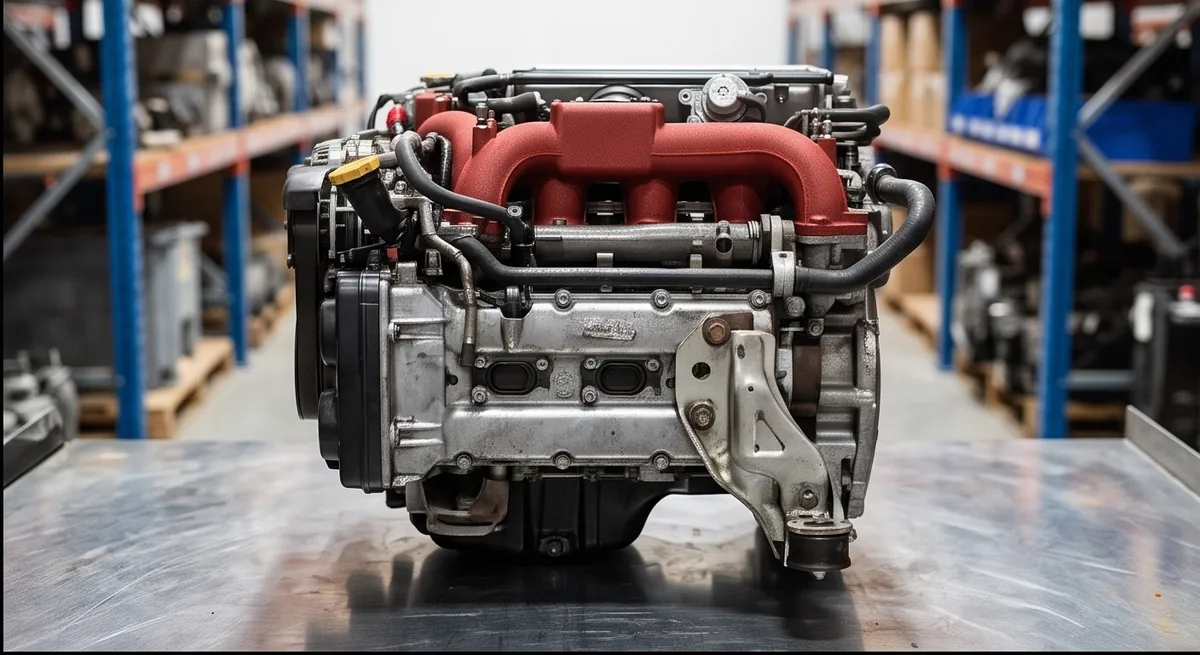

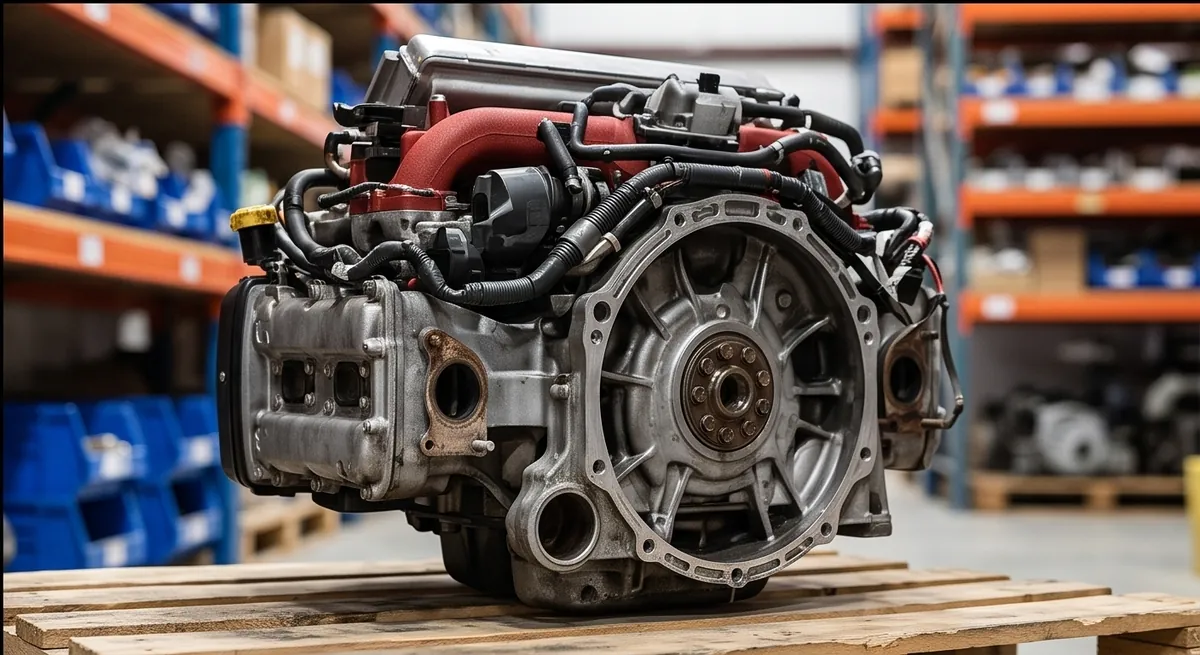
Subaru EJ255 Engine for Sale | OEM Used Subaru EJ255 2.5 Liter Turbocharged
$1,600.00
At a Glance
- Condition: OEM used, compression and leak-down tested all 4 cylinders
- Availability: In stock, Subaru EJ255 WRX Turbo boxer-4 engine available
- Shipping: Free shipping to all 50 states via heavy freight, 7 to 14 business days
- Engine verified as EJ255 (the specific 2.5L WRX Turbo variant within the broader EJ25 Turbo family)
- Year confirmed (EJ255 US production approximately 2006-2018 in WRX, 2005 plus in Legacy GT / Forester XT / Outback XT)
- Application confirmed (Subaru WRX Turbo 2006-2018 sedan and hatchback, Legacy GT Turbo, Forester XT, Outback XT)
- Horsepower rating documented (224-265 HP across years and applications)
- Compression and leak-down tested all 4 cylinders
- Both cylinder heads condition documented (DOHC AVCS heads)
- Turbocharger condition assessed (IHI VF-series turbo)
- Head gasket condition assessed (DOHC turbo EJ family concern)
- Timing belt condition assessed
- NOT the EJ257 STI Turbo, NOT the Cosworth-built EJ257
- 15 day replacement warranty on internal defects
Description
About the Subaru EJ255 WRX Turbo Engine
Looking for a replacement Subaru EJ255 engine? Part Nests stocks OEM used Subaru EJ255 2.5L turbocharged horizontally-opposed boxer-4 engines. The EJ255 is the specific Subaru engine code for the 2.5L WRX Turbo variant within the broader EJ25 Turbo family (per our listing covering both EJ255 and EJ257, and per our EJ25 listing from covering the broader EJ25 family). The EJ255 succeeded the 2.0L EJ205 (per our listing) in US-market WRX applications starting 2006, providing more low-end torque from the larger 2.5L displacement. Production spanned approximately 2006-2018 in WRX applications with output ranging from 224-265 HP across years.
Engine Overview: EJ255 Architecture
- Displacement: 2.5 liters (2,457 cc)
- Configuration: Horizontally-opposed boxer-4 (180-degree opposed cylinders, Subaru signature design)
- Bore x Stroke: 99.5 mm x 79 mm
- Power Output: 224-265 HP at 5,200-6,000 RPM (varies by year and application)
- Peak Torque: 226-258 lb-ft at 2,800-4,400 RPM
- Cylinder Head: Aluminum, DOHC with AVCS (Active Valve Control System)
- Block: Aluminum (open-deck construction, the lower-cost block design vs the EJ257 STI semi-closed deck)
- Compression Ratio: Approximately 8.4:1
- Fuel System: Port fuel injection (PFI) with WRX-spec injectors
- Turbocharger: IHI VF-series turbo (varying versions across years; VF52 most common in mid-production WRX)
- Intercooler: Top-mount intercooler (the iconic Subaru WRX hood scoop)
- Internals: Cast pistons in most variants, standard connecting rods (NOT forged like EJ257 STI)
- Timing belt driven (timing belt service every 105,000 miles is critical)
- Production: Approximately 2006-2018 in primary WRX application
CRITICAL EJ255 vs EJ257 Distinction
The EJ255 (this listing) and EJ257 (per our listing) are both EJ25 Turbo variants within the same family, but they are NOT interchangeable. Critical differences:
- EJ255 (this listing, WRX Turbo): 224-265 HP, open-deck aluminum block, cast pistons in most variants, smaller IHI VF-series turbo, WRX-spec ECU calibration
- EJ257: 293-310 HP, semi-closed deck aluminum block (improved high-boost capability), forged pistons in some variants, stronger connecting rods, larger IHI VF-series turbo, STI-spec ECU calibration
- Cosworth EJ257: Cosworth-built upgrade variant of EJ257 with 450-700 plus HP capability
Specify EJ255 vs EJ257 when ordering. Calling (855) 634-4447 to confirm WRX vs STI vs Cosworth variant is essential.
EJ255 vs EJ205 Predecessor: Why Subaru Switched to 2.5L
The EJ255 (this listing) succeeded the 2.0L EJ205 (per our listing) in US-market WRX applications starting 2006. Why the change:
- Low-end torque: The 2.5L EJ255 produces more low-end torque from the larger displacement (226-258 lb-ft starting at 2,800 RPM) vs the 2.0L EJ205 (217 lb-ft starting at 4,000 RPM). This makes the EJ255 more accommodating for daily driving.
- Power delivery: The 2.0L EJ205 required higher RPM to deliver power; the 2.5L EJ255 provides more usable power across the rev range
- Peak power similar: Peak HP is similar between EJ205 (227 HP) and early EJ255 (224 HP), but the 2.5L’s broader torque curve makes it feel more responsive
- Same architecture: Both share the EJ-family DOHC AVCS architecture; EJ255 is the displacement increase of the EJ-family turbo platform
- Bugeye / Blobeye 2.0L to Hawkeye / VA 2.5L transition: 2002-2003 Bugeye and 2004-2005 Blobeye used EJ205 2.0L; 2006-2007 Hawkeye and later generations transitioned to EJ255 2.5L
EJ255 Applications
- Subaru Impreza WRX (US market 2006-2014, sedan and hatchback): Primary EJ255 application, 224-265 HP across years
- Subaru WRX (US market 2015-2018, VA generation sedan only): Final EJ255 production years before FA20DIT transition
- Subaru Legacy GT Turbo (2005-2009): Legacy GT performance variant with EJ255
- Subaru Forester XT (2006-2013): Forester XT turbo application
- Subaru Outback XT (2005-2009): Outback XT turbo application
- EJ255 succeeded by FA20DIT in 2015 US WRX: The 2015 model year US WRX transitioned to the 2.0L FA20DIT for North American sedan; some markets retained EJ255 longer
Subaru Boxer Engine Family Context
The Subaru EJ255 (this listing) is the specific 2.5L WRX Turbo variant within the EJ25 Turbo family. For broader context across our catalog and prior batches, the Subaru EJ25 Turbo engine (our listing) covers the broader EJ25 Turbo family with both EJ255 and EJ257 variants. The Subaru EJ257 engine (our listing) is the STI Turbo sibling. The Cosworth EJ257 crate engine (our listing) is the Cosworth-built upgrade variant with 450-700 plus HP capability. The Subaru EJ205 engine (our listing) is the 2.0L predecessor in US WRX 2002-2005. The Subaru FA20DIT engine (our listing) is the modern FA family 2.0L direct-injection turbo successor that replaced EJ255 in 2015 US WRX. The Subaru WRX engines (our listing) provides WRX engine overview context. For broader EJ25 family context, the Subaru EJ25 engine (our listing) covers the broader EJ25 family with both turbo and non-turbo variants. The Subaru FB25 engine (our listing) is the modern FB family NA successor.
Common EJ255 Failure Modes
- Head gasket failure (DOHC turbo internal pattern): Internal coolant intrusion pattern; less common than SOHC NA external leak but more severe
- Turbocharger failure: IHI VF-series turbo wear at 100,000-150,000 miles is well-documented
- Rod knock from heavy modification: Aftermarket high-boost tuning beyond 300-350 HP can cause rod knock on stock EJ255 cast-piston internals
- Timing belt: Every 105,000 miles critical; failure damages interference engine
- AVCS solenoid wear: AVCS solenoids fail causing variable valve timing codes
- Ringland failure (heavy modification): Aftermarket aggressive tuning can crack piston ringlands on cast pistons
- Spark plug access: Difficult than inline engines; budget extra labor
Vehicle Compatibility
| Feature | EJ255 (This Listing, Mainstream Turbo) | EJ257 (WRX STI Variant) |
|---|---|---|
| HP | 224-265 HP | 300-305 HP |
| Torque | 226-244 lb-ft | 290 lb-ft |
| Turbocharger | IHI VF52 typical | IHI VF48 typical |
| Connecting Rods | Cast | Forged |
| Crankshaft | Cast | Cast |
| Pistons | Cast | Cast |
| Compression | 8.4:1 | 8.2:1 |
| Block | Open-deck | Open-deck (semi-closed on later) |
| Common Applications | WRX, Forester XT, Legacy GT, Outback XT | WRX STI only |
| Stock Block Safe Power | ~350 HP | ~400-450 HP |
| Stock Price (Used) | $1,200-2,800 | $3,500-7,500 |
EJ255 Architecture and Year Variant Specifications
| Vehicle | Years with EJ255 | Notes |
|---|---|---|
| Subaru WRX | 2006-2014 | Replaced older EJ205 in 2006 with the 2.5L upgrade |
| Subaru Forester XT | 2005-2013 | The first-generation turbo Forester |
| Subaru Legacy GT | 2005-2012 | The performance Legacy variant, spec B reaches 265 HP |
| Subaru Outback XT | 2005-2009 | Performance Outback variant, side-mount intercooler |
| Subaru Baja Turbo | 2004-2006 | Rare Baja turbo variant |
Common Failure Modes and Maintenance Reference
| Vehicle | Compatibility |
|---|---|
| Subaru WRX (non-STI) | 2006-2014 with EJ255 turbo (replaced EJ205 in 2006) |
| Subaru Forester XT | 2005-2013 with EJ255 turbo |
| Subaru Legacy GT | 2005-2012 with EJ255 turbo (spec B reaches 265 HP) |
| Subaru Outback XT | 2005-2009 with EJ255 turbo (side-mount intercooler) |
| Subaru Baja Turbo | 2004-2006 rare turbo Baja variant |
Why Buy From Part Nests
- Engine verified as EJ255 (the specific 2.5L WRX Turbo variant within the broader EJ25 Turbo family)
- Year confirmed (EJ255 US production approximately 2006-2018 in WRX, 2005 plus in Legacy GT / Forester XT / Outback XT)
- Application confirmed (Subaru WRX Turbo 2006-2018 sedan and hatchback, Legacy GT Turbo, Forester XT, Outback XT)
- Horsepower rating documented (224-265 HP across years and applications)
- Compression and leak-down tested all 4 cylinders
- Both cylinder heads condition documented (DOHC AVCS heads)
- Turbocharger condition assessed (IHI VF-series turbo)
- Head gasket condition assessed (DOHC turbo EJ family concern)
- Timing belt condition assessed
- NOT the EJ257 STI Turbo, NOT the Cosworth-built EJ257
- Free shipping to all 50 states via heavy freight
- 15 day replacement warranty on internal defects
- Subaru-experienced support team familiar with EJ255 vs EJ257 distinction and WRX applications
- Call (855) 634-4447 to confirm your application before we ship.
15 Day Replacement Warranty
Every used Subaru EJ255 engine purchased through Part Nests carries a 15 day replacement warranty starting on the delivery date.
What Is Covered
- Internal defects already present when the engine arrives
- Compression failures on any of the 4 cylinders beyond what was disclosed
- Cylinder head crack failures within 15 days from installation (both heads on the boxer-4)
- Block crack failures within 15 days from installation
- Connecting rod, bearing, or crankshaft failures within 15 days from installation
- Head gasket failures within 15 days from installation
- Turbocharger internal failures within 15 days from installation (where turbocharger was supplied and tested)
- Timing belt failures within 15 days from installation
- AVCS solenoid failures within 15 days from installation
- Incorrect variant shipped (EJ255 vs EJ257 mismatch where variant was documented) due to an error on our end
What Is Not Covered
- Damage caused during installation
- Damage from incorrect engine oil (Subaru specifies synthetic oil for EJ255 turbo)
- Damage from extended oil change intervals (3,000-3,750 mile intervals strongly recommended for turbo variants)
- Damage from contaminated fuel (EJ255 requires 91 octane minimum)
- Damage from a single overheating event (cooling integrity is critical)
- Damage from aftermarket high-boost tuning beyond stock power levels (the cast pistons and standard rods in EJ255 are NOT designed for power levels beyond approximately 300-350 HP)
- Damage from cross-application (EJ255 installed where EJ257 was needed without ECU and fuel system verification, or vice versa)
- Damage from neglected timing belt replacement (every 105,000 miles is critical)
- External components (intake manifold, exhaust manifolds, turbocharger if not supplied or noted as ancillary, intercooler, ECU and wiring harness, accessory drive, transmission, AC compressor, alternator, starter, fuel tank, fuel lines outside engine) unless itemized
- Labor expenses of any kind
To start a warranty claim, reach us within 15 days of delivery at (855) 634-4447.
- All 4 Cylinders Compression and Leak-Down Tested: Results documented before payment
- Engine Verified: EJ255 2.5L WRX Turbo (NOT EJ257 STI, NOT Cosworth EJ257)
- Year Confirmed: 2006-2018 in WRX, 2005 plus in Legacy GT / Forester XT / Outback XT
- Application Confirmed: WRX Turbo / Legacy GT / Forester XT / Outback XT
- Horsepower Rating Documented: 224-265 HP across years
- Turbocharger Condition Assessed: IHI VF-series turbo checked
- Head Gasket Condition Assessed: DOHC turbo EJ family concern
- 15 Day Replacement Cover: Internal defects protected from delivery onward
Additional information
| Brand | Subaru |
|---|---|
| engine-type | Flat-4 (horizontally opposed boxer), turbocharged, DOHC |
| engine-variant | EJ255 specifically (2.5L turbo, non-STI variant) |
| engine-family | Subaru EJ-series, turbocharged 2.5L sub-family |
| manufacturer | Subaru Corporation |
| configuration | Flat-4 horizontally opposed boxer |
| displacement | 2.5L (2, 457 cc) |
| bore-x-stroke | 99.5 mm x 79.0 mm |
| hp-live-page-stock | 224 HP at 5, 200 RPM |
| hp-range-across-variants | 224-265 HP |
| torque-live-page-stock | 226 lb-ft at 2, 800 RPM |
| torque-range | 226-244 lb-ft |
| compression | 8.4:1 |
| aspiration | Turbocharged with intercooler |
| turbocharger | IHI VF52 typical |
| intercooler | Top-mount (WRX/Forester XT) or side-mount (Legacy GT/Outback XT) |
| fuel-system | Sequential multi-port injection |
| fuel-type | Premium 91 octane minimum, 93 recommended |
| valvetrain | DOHC per bank, 16 valves, AVCS intake + exhaust |
| block-material | Open-deck aluminum |
The 2.5L WRX Turbo variant within the EJ25 Turbo family. The Subaru EJ255 is the specific Subaru engine code for the 2.5L WRX Turbo variant within the broader EJ25 Turbo family (per our listing covering both EJ255 and EJ257, and per our EJ25 listing from covering the broader EJ25 family). The EJ255 succeeded the 2.0L EJ205 (per our listing) in US-market WRX applications starting 2006, providing more low-end torque from the larger 2.5L displacement. Production spanned approximately 2006-2018 in WRX applications. Specifications: 2.5 liters (2,457 cc), horizontally-opposed boxer-4, bore x stroke 99.5 mm x 79 mm, 224-265 HP at 5,200-6,000 RPM, aluminum DOHC AVCS heads, aluminum open-deck block, compression 8.4:1, port fuel injection with WRX-spec injectors, IHI VF-series turbo, top-mount intercooler, timing belt driven.
WRX Turbo vs STI Turbo with substantial architecture differences. The EJ255 (this listing, WRX Turbo): 224-265 HP, open-deck aluminum block, cast pistons in most variants, smaller IHI VF-series turbo, WRX-spec ECU calibration. The EJ257: 293-310 HP, semi-closed deck aluminum block (improved high-boost capability), forged pistons in some variants, stronger connecting rods, larger IHI VF-series turbo, STI-spec ECU calibration. The Cosworth EJ257 is Cosworth-built upgrade variant of EJ257 with 450-700 plus HP capability. Cross-application requires substantial supporting modifications. Specify EJ255 vs EJ257 when ordering. Calling (855) 634-4447 to confirm WRX vs STI vs Cosworth variant is essential.
2.5L successor providing more low-end torque vs 2.0L predecessor. The EJ255 (this listing) succeeded the 2.0L EJ205 (per our listing) in US-market WRX applications starting 2006. Why the change: low-end torque - the 2.5L EJ255 produces more low-end torque from the larger displacement (226-258 lb-ft starting at 2,800 RPM) vs the 2.0L EJ205 (217 lb-ft starting at 4,000 RPM); this makes the EJ255 more accommodating for daily driving. Power delivery: the 2.0L EJ205 required higher RPM to deliver power; the 2.5L EJ255 provides more usable power across the rev range. Peak power similar: EJ205 227 HP vs early EJ255 224 HP but the 2.5L's broader torque curve makes it feel more responsive. Same architecture: both share the EJ-family DOHC AVCS architecture. Bugeye / Blobeye 2.0L to Hawkeye / VA 2.5L transition occurred in 2006.
Five primary applications across WRX, Legacy GT, Forester XT, Outback XT. Subaru Impreza WRX (US market 2006-2014, sedan and hatchback): primary EJ255 application, 224-265 HP across years. Subaru WRX (US market 2015-2018, VA generation sedan only): final EJ255 production years before FA20DIT transition. Subaru Legacy GT Turbo (2005-2009): Legacy GT performance variant with EJ255. Subaru Forester XT (2006-2013): Forester XT turbo application. Subaru Outback XT (2005-2009): Outback XT turbo application. EJ255 was succeeded by FA20DIT in 2015 US WRX (the 2015 model year US WRX transitioned to the 2.0L FA20DIT for the VA-generation North American sedan; some markets retained EJ255 longer).
Seven well-documented modes. Head gasket failure (DOHC turbo internal pattern): internal coolant intrusion pattern; less common than SOHC NA external leak but more severe. Turbocharger failure: IHI VF-series turbo wear at 100,000-150,000 miles is well-documented. Rod knock from heavy modification: aftermarket high-boost tuning beyond 300-350 HP can cause rod knock on stock EJ255 cast-piston internals. Timing belt: every 105,000 miles critical; failure damages interference engine. AVCS solenoid wear: AVCS solenoids fail causing variable valve timing codes. Ringland failure (heavy modification): aftermarket aggressive tuning can crack piston ringlands on cast pistons. Spark plug access: difficult than inline engines; budget extra labor.
Multiple Subaru engines across batches 29-30 with EJ255 as WRX Turbo variant. The Subaru EJ255 (this listing) is the specific 2.5L WRX Turbo variant within the EJ25 Turbo family. references: EJ25 Turbo broader family with both EJ255 and EJ257, EJ257 STI Turbo sibling, Cosworth EJ257 upgraded variant, EJ205 2.0L predecessor in US WRX 2002-2005, FA20DIT modern FA family 2.0L direct-injection turbo successor that replaced EJ255 in 2015 US WRX, Subaru WRX engines overview, FB25 modern FB family NA successor. references: EJ25 broader family, FA20 modern Subaru / Toyota co-developed FA family. The EJ255 represents the mid-life WRX engine bridging the early EJ205 era and the modern FA20DIT era.
Head gasket assessment, timing belt, turbo inspection, fuel system. After acquiring a used EJ255 engine, budget for these items. Head gasket assessment: budget $1,500-3,500 for proactive MLS head gasket replacement with ARP head studs at acquisition for high-mileage examples. Timing belt service: budget $800-1,500 for full timing belt service including water pump, tensioner, idler pulleys; every 105,000 miles is critical. Turbo inspection: budget $1,500-3,500 for turbo replacement if at high mileage (IHI VF-series turbo wear 100,000-150,000 miles is well-documented). AVCS solenoid inspection: replace if codes present. Strict synthetic oil maintenance: 3,000-3,750 mile intervals with Subaru-approved synthetic oil for turbo. Premium 91 octane minimum fuel required. For aftermarket modifications beyond stock power, budget supporting modifications including upgraded fuel system, intercooler, and intake/exhaust.
No. There is no core return required.
2 reviews for Subaru EJ255 Engine for Sale | OEM Used Subaru EJ255 2.5 Liter Turbocharged
Related products




Ezekiel C. –
Got mine for the Subaru EJ255 Engine. In and installed same weekend.
Magnolia T. –
Fit the Subaru EJ255 Engine the way it should. No hassles.