
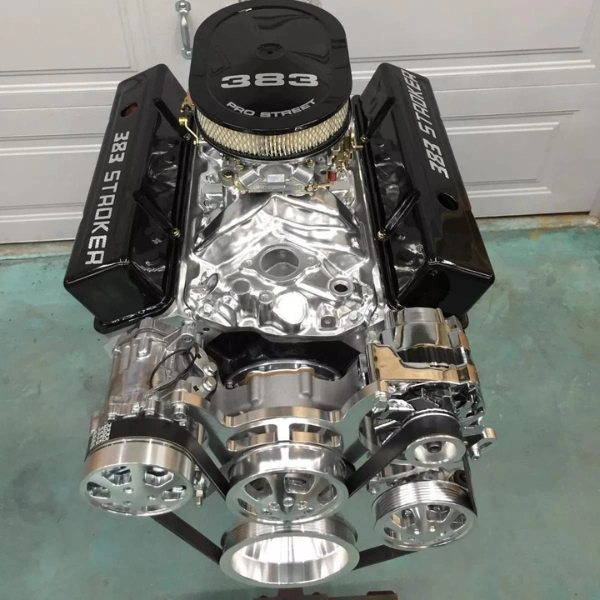
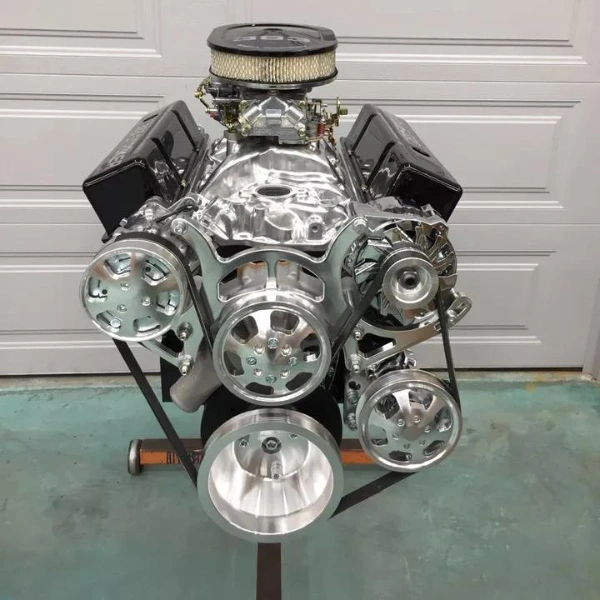
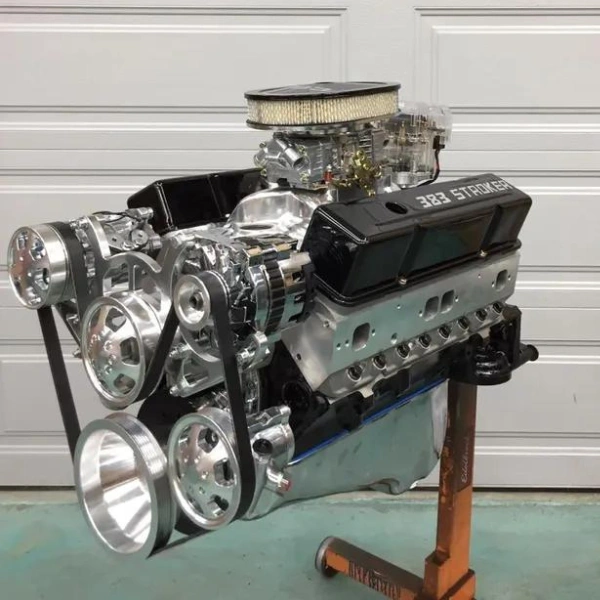
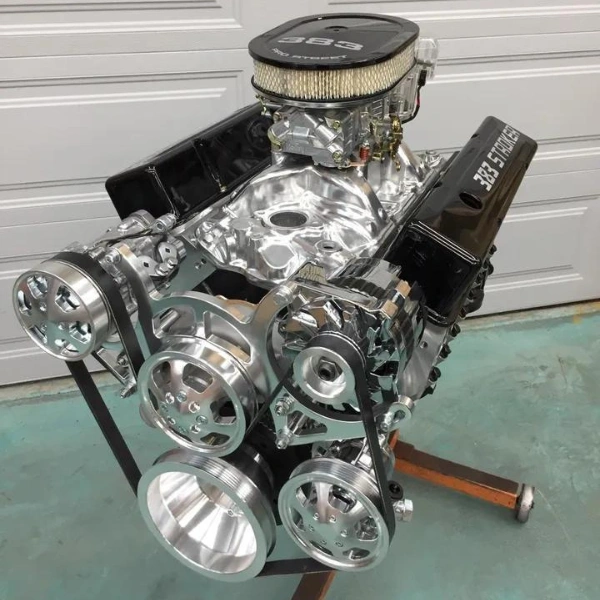
383 Stroker Engine for Sale | SBC Small Block Chevy 383ci V8
$3,999.00
Product Overview
- Displacement: 383 cu in (6.3L)
- Engine Family: GM Small Block Chevy (SBC) stroker
- Configuration: V8, OHV, 16 valves
- Horsepower: 350 to 500+ hp, build dependent, confirmed at order
- Condition: New build or used assembled, confirmed at order
- Build specifications documented before every order: heads, cam, compression, output
- Shipping: Free freight to all 50 states, 5 to 10 business days
- Assembled engines compression-tested before shipping
- Crankshaft type and rod length confirmed before shipping
- Zero core charge required on complete assembled units
- Backed by a 15 day replacement warranty against internal defects
Did you like this product? Add to favorites now and follow the product.
(+800) 1234 5678 90 Start Live Chat
Description
Engine Background
The 383 stroker is the most popular performance small block build in American hot rodding history. It starts with the proven GM Small Block Chevy 350 block, bored 0.030 inch over to 4.030 inches, then receives a crankshaft with a 3.750 inch stroke. The combination produces 383 cubic inches in a package that retains the SBC’s compact dimensions, widespread parts support, and easy bolt-in fitment to any vehicle that originally carried a small block Chevy.
The appeal of the 383 over simply building a high-output 350 comes down to torque. The longer stroke (from 3.480 inches on a 350 to 3.750 inches) increases piston velocity and improves cylinder fill at low engine speeds. The result is a broad, flat torque curve that makes the 383 feel significantly larger than its cubic inches suggest. Well-built street 383 engines with hydraulic roller cams and aluminum heads consistently produce 420 to 500 horsepower and 430 to 475 lb-ft of torque on pump gas, numbers that rival many big block combinations at a fraction of the weight and cost.
The 383 fits directly into any vehicle built around an SBC: no custom mounts, no bell housing changes, no chassis modifications. For Camaro, Chevelle, Nova, Corvette, C/K truck, El Camino, and countless custom builds, the 383 stroker is the most proven and most supported high-performance V8 available today. Call (240) 306-7051 to discuss your specific build target.
When Replacement Becomes Necessary
- Oil consumption above expected levels, ring seal issue on high-mileage assembled units or improper ring gap on new builds
- Detonation or pinging under load, compression too high for fuel being used, or timing not optimized for the specific cam and compression combination
- Lifter tick on startup, common on roller cam builds that sat for extended periods, typically resolves after a few heat cycles
- Loss of compression on one or more cylinders, ring or valve issue on assembled units
- Excessive blow-by past PCV, ring seal not seated properly on a new or rebuilt unit that needs break-in miles
Known Issues We Document Before Shipping
- Rod ratio and piston-to-wall clearance: the 383 uses a longer stroke than the 350, which increases piston side loading in the cylinder. Proper piston-to-wall clearance and the correct connecting rod length (5.700 or 6.000 inch) are critical for longevity. We document rod length on every unit.
- Crankshaft compatibility: using a reworked GM 400 SBC crankshaft in a 350 block requires the 400’s external balance to be corrected. The 400 is externally balanced while most 350 applications are internally balanced. A 383 built with an aftermarket internally balanced forged crank avoids this issue. We document crankshaft type and balance specification for every unit.
- Head selection and output: a 383 with stock cast iron Vortec heads and a mild hydraulic roller cam produces approximately 380 to 420 hp. Aftermarket aluminum heads with bigger valves and improved ports push output to 450 to 500-plus hp. We document head type and casting on every unit.
- Cam selection matters: hydraulic roller cams in the 220 to 235 degrees at .050 inch duration range produce strong street-driver 383s. Larger solid roller cams require stiffer valve springs and reduce streetability. We disclose cam specification on every unit.
- Break-in for new builds: new 383 builds require proper break-in (varied rpm, no sustained load for first 500 miles, conventional non-synthetic break-in oil with ZDDP) for ring seating. Improper break-in causes ring seal issues that cannot be corrected later without disassembly.
383 Stroker Build Specifications
Critical buyer information for matching the build to your application:
| Build Level | HP Range | Torque Range | Typical Specs |
|---|---|---|---|
| Entry Street | 350 to 400 hp | 400 to 430 lb-ft | Cast iron heads, hydraulic roller cam, 9.5:1 compression, 750 cfm 4-barrel carb. |
| Mid Performance | 400 to 450 hp | 430 to 460 lb-ft | Aftermarket aluminum heads, hydraulic roller cam, 10.0:1 compression, 750 to 850 cfm carb. |
| High Performance | 450 to 500 hp | 450 to 475 lb-ft | High-flow aluminum heads, aggressive hydraulic or solid roller cam, 10.5:1 compression, 850 cfm carb. |
| Forced Induction | 500 to 700+ hp | 500+ lb-ft | Lower compression (8.5 to 9.0:1), turbo or supercharger, upgraded internals. Build-specific. |
| INCLUDED- Long Block (standard) | Assembled block, crankshaft, pistons, connecting rods, camshaft and lifters, cylinder heads, valve train, timing set, oil pan, front cover, and valley cover or intake gaskets. |
|---|---|
| INCLUDED- Dressed Versions (call to confirm) | Some units include intake manifold, carburetor, valve covers, distributor, and accessories. Confirm at time of order. |
| NOT INCLUDED (standard long block) | Carburetor or EFI system, intake manifold, exhaust manifolds or headers, distributor, ignition system, alternator, power steering pump, starter, accessories. |
| Core Note | No core charge on complete assembled units. |
What Ships and What Does Not
| Chevrolet Camaro | 1967 to 2002 (all SBC-equipped years) |
|---|---|
| Chevrolet Chevelle and Malibu | 1964 to 1977 |
| Chevrolet Nova | 1962 to 1979 |
| Chevrolet Corvette | 1955 to 1996 (SBC years) |
| Chevrolet C/K Truck and Suburban | 1967 to 1999 |
| GMC C/K Truck | 1967 to 1999 |
| El Camino and Monte Carlo | Various SBC years |
| Custom and Kit Car Applications | Universal SBC fitment- most common performance swap engine |
Direct-Fit Vehicle Applications
| 383 stroker | Most common buyer search |
|---|---|
| 383 SBC | SBC abbreviation buyer |
| 383 small block Chevy | Full designation buyer |
| 383 crate engine | Crate and builder buyer |
| 383 stroker motor | Motor vs engine term |
| Chevy 383 engine | Brand-specific buyer |
| 383ci engine | Displacement format |
| 383 stroker 400 hp | Output-specific buyer |
| 383 performance engine | General performance buyer |
| 383 assembled engine | Assembled ready-to-install buyer |
Not sure if this fits? Call us at (240) 306-7051. We verify build specifications, target output, and supporting hardware requirements before every order ships.
New Build Versus Used Assembled
New 383 strokers are built to specification with fresh internals: forged crank, forged or hypereutectic pistons, new bearings, fresh rings, refreshed or new heads, and a target cam profile. New builds run $4,500 to $9,000-plus depending on heads, cam, and supporting components. Used assembled 383s have already been broken in, dynoed, and proven to make power. Cost saving versus new can be $2,000 to $4,000 depending on condition and documentation. Both paths produce a strong 383; the choice depends on budget, build target, and timeline.
Inspection Workflow
- Compression test logged across all 8 cylinders with uniformity reported (assembled units)
- Crankshaft type documented: internally balanced aftermarket forged or externally balanced reworked GM 400
- Connecting rod length identified: 5.700 inch or 6.000 inch
- Head casting and type documented: cast iron Vortec, aluminum aftermarket, or other
- Cam specification disclosed: hydraulic roller duration and lift
- Compression ratio specified: pump gas compatible or higher-octane required
- Dyno sheet available on request for proven units
Pre-Purchase Buyer Notes
- Match build to your fuel and tune: a 10.5:1 to 11.0:1 compression 383 needs premium pump gas. Higher compression requires race fuel. Confirm your fuel availability before ordering.
- Internally balanced versus externally balanced affects flywheel and harmonic balancer: internally balanced 383s use a neutral-balance flywheel and harmonic balancer. Externally balanced 383s require the matching weighted components. Wrong balance causes vibration and bearing damage.
- Plan supporting hardware: a 450-plus hp 383 needs a strong transmission, capable rear axle, fuel pump sized for the output, and matching cooling system. Plan these as part of the build budget.
- Break-in is critical for new builds: 500 miles of varied rpm operation with conventional break-in oil and ZDDP additive. Skipping break-in causes ring seal issues that cannot be repaired later.
- Carb versus EFI configuration: most 383 strokers ship with a carbureted top end (Holley 670 to 750 cfm typical). EFI top ends are available on request but cost more. Discuss configuration on the call.
Why Buy From Part Nests
- Build specifications documented before payment: heads, cam, compression, target output
- Crankshaft type and balance specification disclosed
- Connecting rod length identified: 5.700 or 6.000 inch
- Head casting and type recorded
- All 8 cylinders compression-tested on assembled units
- Dyno sheet available on request for proven units
- No core return required on complete assembled units
- Free freight delivery to every state
- 15 day replacement warranty against internal defects
- Call (240) 306-7051 to speak with someone who knows 383 stroker build specifications, internally versus externally balanced crank requirements, and Vortec versus aftermarket aluminum head pairing
Additional information
| displacement | 383 cu in (6.3L) |
|---|---|
| engine-family | GM Small Block Chevy (SBC) |
| configuration | 16 valves, OHV, V8 |
| bore | 4.030 in (350 block bored 0.030 over) |
| stroke | 3.750 in |
| firing-order | 1-8-4-3-6-5-7-2 |
| horsepower | 350 to 500+ hp- build dependent, confirmed at order |
| torque | 400 to 475 lb-ft- build dependent, confirmed at order |
| compression-ratio | 9.5:1 to 10.5:1 typical- confirmed at order |
| crankshaft | Reworked 400 SBC or aftermarket forged stroker- confirmed at order |
| balance | Internally or externally balanced- confirmed at order |
| condition | New build or used assembled- confirmed at order |
A small block Chevy build that combines a 350 block (bored 0.030 inch over to 4.030 inches) with a crankshaft of 3.750 inch stroke (versus the 350's 3.480 inch stroke). The combination produces 383 cubic inches in a package that retains all SBC bell housing, motor mount, and accessory drive compatibility. It is the most popular performance SBC build in hot rodding history.
Torque. The 383's longer stroke increases piston velocity and improves low-end cylinder fill. The result is a broader, flatter torque curve than a same-output 350 can produce. A 450 hp 383 makes more torque at 2,500 rpm than a 450 hp 350 typically does, which transforms street drivability.
Where the rotating assembly counterweight is located. An internally balanced 383 uses a neutral-balance flywheel and harmonic balancer; all counterweight is integrated into the crankshaft itself. An externally balanced 383 (typically using a reworked GM 400 crankshaft) requires the counterweight to be integrated into the flywheel and harmonic balancer. Wrong combination causes severe vibration.
350 to 500-plus hp depending on the build. A mild street 383 with Vortec heads and a hydraulic roller cam produces 380 to 420 hp. A 383 with aftermarket aluminum heads, a larger cam, and supporting hardware reaches 450 to 500-plus hp. Pure race builds push 600-plus hp on race fuel.
Yes. The 383 stroker uses the standard SBC bell housing, motor mounts, and accessory drive layout. It fits directly into any vehicle that originally accepted a small block Chevy with no chassis modifications. Camaro, Chevelle, Nova, Corvette, C/K truck, El Camino, Impala, and countless other GM chassis all accept a 383 directly.
Build dependent. A 9.5:1 to 10.0:1 compression 383 runs on regular 87-octane pump gas. A 10.5:1 to 11.0:1 compression 383 requires premium 91 or 93 octane. Higher compression race builds need race fuel. Confirm compression ratio and fuel availability before ordering.
Strong transmissions are recommended. A 450-plus hp 383 with high torque output destroys weak transmissions. Built TH350, TH400, 700R4, 4L60E, or 4L80E units with race-grade internals are the appropriate match. Stock automatic transmissions in moderate-power cars work, but towing or aggressive driving demands a built unit.
No. There is no core return required on complete assembled units.
15 Day Replacement Warranty
Every 383 stroker engine purchased through Part Nests carries a 15 day replacement warranty starting on the delivery date.
What Is Covered
- Internal defects already present when the engine arrives
- Performance materially different from how the engine was described
- Incorrect part shipped due to an error on our end
What Is Not Covered
- Damage caused during installation
- Damage from improper break-in on new builds (varied rpm, ZDDP break-in oil, no sustained load for first 500 miles required)
- Damage from incompatible components or wrong fuel grade
- External components unless specifically itemized
- Labor expenses of any kind
To start a warranty claim, reach us within 15 days of delivery at (240) 306-7051.
- Build Specs Documented: Heads, cam, compression, target output before payment
- Crankshaft Type Disclosed: Internally balanced or externally balanced flagged
- Rod Length Identified: 5.700 inch or 6.000 inch noted on every order
- Head Type Recorded: Cast iron Vortec or aluminum aftermarket documented
- All 8 Cylinders Tested: Compression on assembled units shared before payment
- 15 Day Replacement Cover: Internal defects protected from delivery onward
4 reviews for 383 Stroker Engine for Sale | SBC Small Block Chevy 383ci V8
Related products
About Us
At Part Nests, we specialize in high-quality used and OEM auto parts, with a wide selection of components ready to ship to customers.
© 2026 Part Nests. All rights reserved.

Jeff D. –
Got a 383 stroker for a 1969 Camaro build. Build specs documented up front (Vortec heads, hydraulic roller cam at 224 degrees at .050, 10.0:1 compression, internally balanced forged crank, 6.000 inch rods). All eight cylinders tested uniform on compression. Bolted in cleanly with the standard SBC engine mounts.
Larry P. –
Sourced a 383 for a 1972 C10 truck build. Aluminum heads, mild hydraulic roller cam, 9.5:1 compression for 87 octane fuel. Crank type confirmed as internally balanced forged. Honest dyno sheet provided showing 425 hp at 5,500 rpm. Pulls cleanly from idle.
Jeff D. –
Got a 383 stroker for a 1969 Camaro build. Build specs documented up front (Vortec heads, hydraulic roller cam at 224 degrees at .050, 10.0:1 compression, internally balanced forged crank, 6.000 inch rods). All eight cylinders tested uniform on compression. Bolted in cleanly with the standard SBC engine mounts.
Larry P. –
Sourced a 383 for a 1972 C10 truck build. Aluminum heads, mild hydraulic roller cam, 9.5:1 compression for 87 octane fuel. Crank type confirmed as internally balanced forged. Honest dyno sheet provided showing 425 hp at 5,500 rpm. Pulls cleanly from idle.