
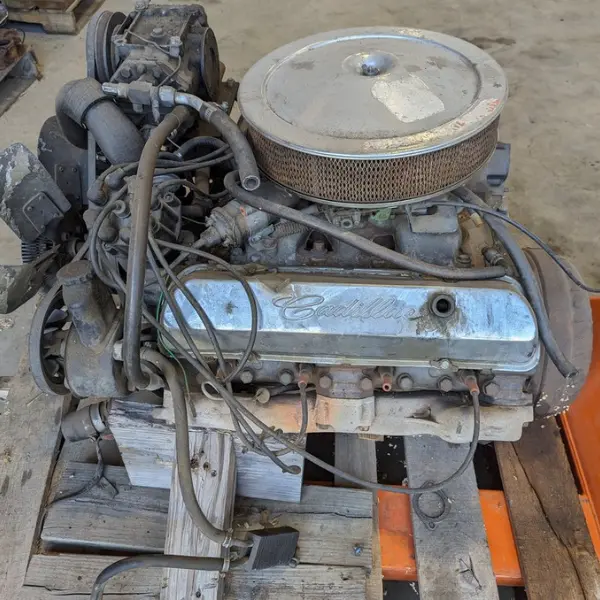
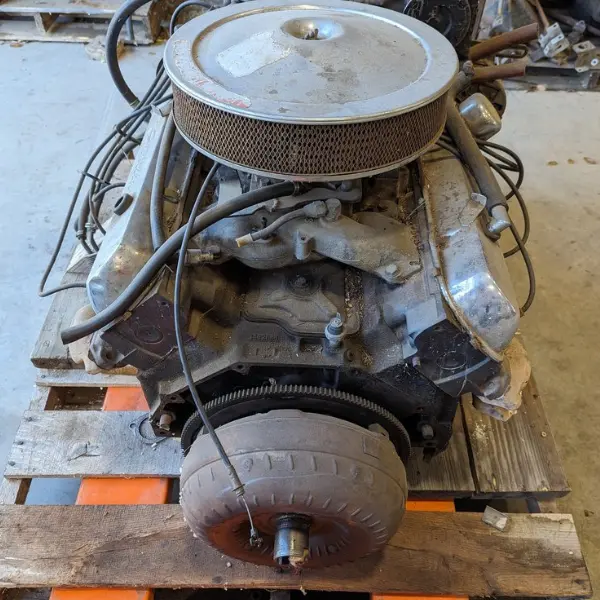
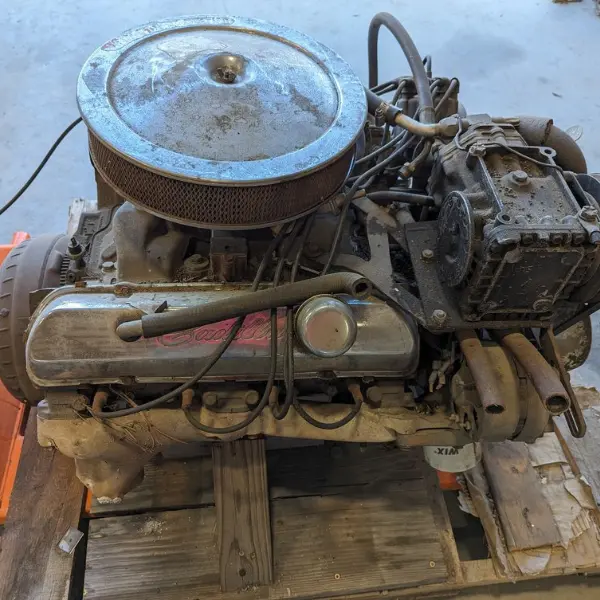
Cadillac 429 Engine for Sale | OEM 1964 to 1967 Big Block V8 (7.0L)
$15,765.00
Product Overview
- Displacement: 429 cu in (7.0L)
- Configuration: V8, OHV, 16 valves
- Horsepower: 340 hp
- Torque: 480 lb-ft
- Condition: OEM used, compression tested and inspected
- Availability: Call (240) 306-7051 to confirm current availability
- Shipping: Free freight to all 50 states, 5 to 10 business days
- All 8 cylinders pressure-tested with results shared before payment
- Casting number and year documented before shipping
- Cadillac 429 versus Ford 429 distinction verified before every order ships
- Zero core charge required, your existing engine stays with you
- Backed by a 15 day replacement warranty against internal defects
Did you like this product? Add to favorites now and follow the product.
(+800) 1234 5678 90 Start Live Chat
Description
Engine Background
The Cadillac 429 is a 429 cubic inch OHV V8 produced by Cadillac from 1964 through 1967, four model years only. It was the natural evolution of the Cadillac 390, enlarged by increasing the bore to 4.125 inches while retaining a 4.000 inch stroke to achieve the larger displacement. At 340 hp and 480 lb-ft of torque, it was one of the most torque-rich American V8 engines of its era, designed not for high-rpm power but for smooth, effortless authority suited to Cadillac’s full-size luxury vehicles.
The 429 powered every Cadillac model from 1964 through 1967: the DeVille, Calais, Eldorado, Fleetwood, Sixty Special, and all commercial chassis applications. By 1967 it had reached the limits of the original 390-series architecture, and Cadillac introduced an entirely new and larger 472 cubic inch engine for 1968, one of the largest passenger car V8 engines ever produced.
Today the Cadillac 429 is a low-volume specialty engine with a small but dedicated restoration community. Clean cores are genuinely scarce, far rarer than the Ford 429 or GM 454. A compression-tested unit with documented casting numbers is a significant find for any classic Cadillac restoration project. Call (240) 306-7051 to confirm current availability.
When Replacement Becomes Necessary
- Oil burning on startup, valve stem seal deterioration on aged engines
- Knock at startup that clears after oil pressure builds, main or rod bearing wear
- Loss of compression on one or more cylinders, ring wear on high-mileage units
- Oil leaks at valve covers and front timing cover, common on aged Cadillac V8s
- Overheating, aged cooling passages and original thermostats need attention on 60-year-old engines
- Low oil pressure at idle after warm-up, bearing wear or oil pump wear
Known Issues We Document Before Shipping
- Limited parts availability: the Cadillac 429 has been out of production for nearly 60 years. Pistons, rings, gaskets, and valvetrain parts are available from Cadillac specialty suppliers but supply is limited. Factor this into your restoration planning.
- Casting number importance: Cadillac used different casting numbers across the four production years. Correct casting documentation is important for show-quality restorations. We document and disclose the casting number of every unit before shipping.
- Crankshaft variants: 1964 Cadillac 429s used two different crankshaft configurations depending on transmission. HydraMatic and Turbo HydraMatic versions used different crank rear journals. We document the crankshaft configuration where identifiable.
- Cadillac versus Ford 429 confusion: these engines are frequently confused. A buyer who needs a Cadillac 429 cannot use a Ford 429; the architecture, dimensions, mounting, and compatibility are completely different. We verify application before every order.
- Oil pan removal: in some Cadillac applications, oil pan removal requires partial engine removal due to the chassis layout. Plan accordingly for any service work involving the bottom end.
Cadillac 429 Variants by Year
Critical buyer information across the 1964 to 1967 production run:
| Year | HP | Torque | Notes |
|---|---|---|---|
| 1964 | 340 hp | 480 lb-ft | First year 429. 10.5:1 compression. Two crankshaft variants depending on transmission (HydraMatic vs Turbo HydraMatic). Positive crankcase ventilation introduced. |
| 1965 | 340 hp | 480 lb-ft | Minimal changes from 1964. Same specs throughout. |
| 1966 | 340 hp | 480 lb-ft | Minor tuning refinements. Same overall output. |
| 1967 | 340 hp | 480 lb-ft | Final year of the 429. Replaced by the all-new 472 cu in V8 for 1968. |
| INCLUDED- Long Block | Block, crankshaft, pistons, connecting rods, camshaft, cylinder heads, valve train, oil pan, timing cover, and water pump where present. |
|---|---|
| NOT INCLUDED | Intake manifold, carburetor, exhaust manifolds, distributor, ignition system, alternator, power steering pump, starter, flexplate or flywheel, accessory brackets. |
| Core Note | No core charge. You are not required to return your old engine. |
What Ships and What Does Not
| Cadillac DeVille (all body styles) | 1964 to 1967 |
|---|---|
| Cadillac Calais | 1965 to 1967 |
| Cadillac Eldorado | 1967 (first-year Eldorado FWD) |
| Cadillac Fleetwood (all variants) | 1964 to 1967 |
| Cadillac Sixty Special | 1964 to 1967 |
| Cadillac Commercial Chassis | 1964 to 1967 (ambulance and hearse applications) |
Direct-Fit Vehicle Applications
| Cadillac 429 | Most common buyer search |
|---|---|
| Cadillac 429 V8 | Configuration search |
| Cadillac 7.0L engine | Displacement-format search |
| 1964 Cadillac engine | Year-specific buyer |
| 1967 Cadillac engine | Final year buyer |
| Cadillac DeVille engine | Application-specific buyer |
| Cadillac Eldorado engine | Eldorado restoration buyer |
| Cadillac big block | Big block designation |
| vintage Cadillac engine | Broad classic buyer |
| Cadillac 390 429 engine | Series history context |
Not sure if this fits? Call us at (240) 306-7051. We verify Cadillac 429 versus Ford 429 and casting number before every order ships.
Used OEM Versus Specialist Rebuild
For a 1964 to 1967 Cadillac DeVille, Calais, Eldorado, Fleetwood, or Sixty Special restoration on a reasonable budget, a documented used 429 with casting number verified and compression results uniform is the cost-effective path. For a show-quality restoration or a high-mileage donor requiring full refresh, a specialist rebuild with fresh internals, refreshed cooling system, and authentic casting verification is the better long-term investment. Specialist Cadillac 429 rebuilds typically run $7,500 to $14,000-plus from established Cadillac restoration shops, plus parts sourcing time.
Inspection Workflow
- Compression test logged across all 8 cylinders with uniformity reported
- Casting number documented from the block
- Year identified from casting number and date code
- Cadillac 429 versus Ford 429 distinction verified (different architectures entirely)
- Crankshaft configuration noted where identifiable (HydraMatic versus Turbo HydraMatic 1964 variants)
- External oil leak survey at valve covers, front timing cover, oil pan
- Cooling passage condition assessed where accessible
Pre-Purchase Buyer Notes
- Verify Cadillac 429 versus Ford 429: these are completely different engines that share only displacement. Architecture, dimensions, mounting points, and compatibility are not interchangeable. We verify the Cadillac casting on every order.
- Plan parts sourcing in advance: 60-year-old engine parts are available from Cadillac specialty suppliers (Cad Company, Caddy Daddy, others) but supply is limited and lead times can be substantial. Source critical parts before disassembly.
- Confirm casting number for show restorations: Cadillac used different casting numbers across the four production years. For a show-quality restoration with judging criteria, casting number authenticity matters. We disclose this on every order.
- Plan a complete cooling system refresh: 60-year-old cooling passages may be restricted with mineral deposits. Plan a thorough flush, new water pump, new thermostat, and consider an aftermarket aluminum radiator for daily-driver use.
- Use ZDDP oil additive: the 429 uses flat-tappet camshafts requiring high-zinc oil. Modern low-zinc oils accelerate cam lobe wear on flat-tappet engines.
Why Buy From Part Nests
- Casting number documented before payment
- Year identified from casting and date codes
- Cadillac 429 versus Ford 429 distinction verified (these are different engines)
- Crankshaft configuration noted where identifiable
- All 8 cylinders compression-tested with uniformity reported
- No core return required
- Free freight delivery to every state
- 15 day replacement warranty against internal defects
- Call (240) 306-7051 to speak with someone who knows Cadillac 429 versus Ford 429 differences, 1964 versus 1965 versus 1966 versus 1967 casting variations, and classic Cadillac application matching
Additional information
| displacement | 429 cu in (7.0L) |
|---|---|
| configuration | 16 valves, OHV, V8 |
| bore-x-stroke | 4.125 in x 4.000 in |
| firing-order | 1-8-4-3-6-5-7-2 |
| aspiration | Naturally Aspirated |
| fuel-system | Rochester 4-barrel carburetor |
| block-material | Cast Iron |
| head-material | Cast iron |
| compression-ratio | 10.5:1 |
| horsepower | 340 hp |
| torque | 480 lb-ft |
| production-years | 1964 to 1967 |
| manufacturer | Cadillac (General Motors) |
| important-note | Cadillac 429- NOT the Ford 429. Completely different engine. |
| compatible-transmissions | Turbo HydraMatic 400 (TH400) | HydraMatic (1964 some applications) |
| condition | compression tested and inspected, Used OEM |
Every Cadillac model from 1964 through 1967 used the 429 as its standard V8 engine. This includes the DeVille, Calais, Eldorado, Fleetwood, Sixty Special, and all commercial chassis applications (limousines, hearses, ambulances). Production ended in 1967 when Cadillac replaced it with the entirely new 472 cubic inch engine for 1968.
No. These are completely different engines that share only displacement. The Cadillac 429 (1964 to 1967) is an OHV V8 derived from the Cadillac 390 family. The Ford 429 (1968 to 1973, also continued in various forms) is part of the Ford 385 series big block family. Architecture, dimensions, mounting points, and parts are completely different. We verify Cadillac casting on every order.
340 hp and 480 lb-ft of torque in factory tune. This was one of the most torque-rich American V8 engines of its era, designed for smooth low-rpm authority rather than high-rpm power. The 480 lb-ft of torque at relatively low rpm gave Cadillac vehicles of the era their characteristic effortless acceleration despite their substantial weight.
The Cadillac 472 cubic inch V8 in 1968, an entirely new design that grew to 500 cubic inches by 1970. The 472 and 500 are different engines from the 429 and not interchangeable. By 1968 Cadillac had reached the displacement limits of the original 390-series architecture and needed a clean-sheet design for further growth.
Production was only four model years (1964 to 1967) compared to the Chevy 350 (35-plus years) or Ford 351 Windsor (27-plus years). Many original 429s were scrapped or rebuilt over the past 60 years. Surviving cores in usable condition are genuinely scarce, far rarer than equivalent Chevy or Ford big blocks of the same era.
Yes, but from specialty suppliers only. Cad Company, Caddy Daddy, and other Cadillac restoration specialists stock pistons, rings, gaskets, valvetrain components, and supporting hardware. Generic parts catalogs typically lack 429-specific components. Plan parts sourcing in advance, with lead times that can be substantial.
1964 Cadillac 429s used two different crankshaft configurations depending on which transmission the car was fitted with. HydraMatic-equipped cars used one crank rear journal configuration; Turbo HydraMatic-equipped cars used a different configuration. The two are not directly interchangeable without matching the rear journal to the transmission input. We document crankshaft configuration where identifiable.
No. There is no core return required.
15 Day Replacement Warranty
Every used Cadillac 429 engine purchased through Part Nests carries a 15 day replacement warranty starting on the delivery date.
What Is Covered
- Internal defects already present when the engine arrives
- Performance materially different from how the engine was described
- Incorrect part shipped due to an error on our end
What Is Not Covered
- Damage caused during installation
- Damage from incompatible components or wrong oil type (modern low-zinc oils on flat-tappet cams)
- External components unless specifically itemized
- Labor expenses of any kind
To start a warranty claim, reach us within 15 days of delivery at (240) 306-7051.
- Casting Number Documented: Block casting recorded before payment
- Year Identified: 1964, 1965, 1966, or 1967 confirmed from casting and date code
- Cadillac vs Ford 429 Verified: Different engines despite shared displacement
- All 8 Cylinders Tested: Compression results shared before payment
- Crankshaft Configuration Noted: 1964 HydraMatic versus Turbo HydraMatic distinction
- 15 Day Replacement Cover: Internal defects protected from delivery onward
4 reviews for Cadillac 429 Engine for Sale | OEM 1964 to 1967 Big Block V8 (7.0L)
Related products
Recently Viewed Products
About Us
At Part Nests, we specialize in high-quality used and OEM auto parts, with a wide selection of components ready to ship to customers.
© 2026 Part Nests. All rights reserved.

Howard B. –
Sourced a Cadillac 429 for a 1966 DeVille restoration. Casting number documented up front, year confirmed as 1966 from the date code, Cadillac-versus-Ford verification specifically called out in the inspection report (this distinction was my main worry). All eight cylinders tested uniform on compression. Foundation for the restoration is solid.
Dale P. –
Got a Cadillac 429 for a 1965 Fleetwood project. Honest about it being a 60-year-old core with aged seals throughout. Plan a complete seal and gasket refresh at install per their note. Compression results uniform. ZDDP additive plan for the flat-tappet cam confirmed. Reasonable replacement for a notoriously hard-to-find engine.
Howard B. –
Sourced a Cadillac 429 for a 1966 DeVille restoration. Casting number documented up front, year confirmed as 1966 from the date code, Cadillac-versus-Ford verification specifically called out in the inspection report (this distinction was my main worry). All eight cylinders tested uniform on compression. Foundation for the restoration is solid.
Dale P. –
Got a Cadillac 429 for a 1965 Fleetwood project. Honest about it being a 60-year-old core with aged seals throughout. Plan a complete seal and gasket refresh at install per their note. Compression results uniform. ZDDP additive plan for the flat-tappet cam confirmed. Reasonable replacement for a notoriously hard-to-find engine.